
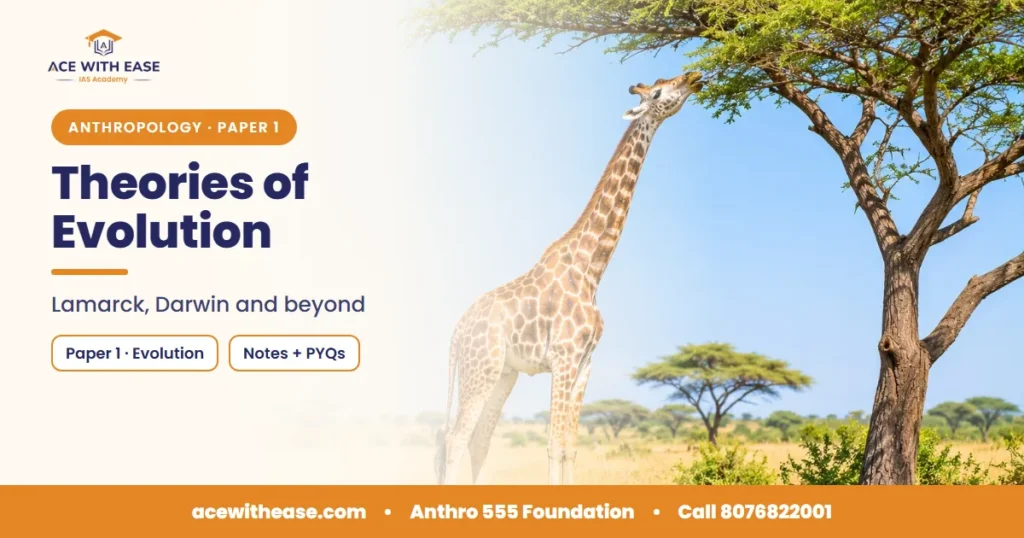
Theories of Evolution: Lamarckism, Darwinism, Mutation Theory and the Synthetic Theory
⏱ 7 min read | ~1549 words
Theories of evolution explain how living species change over time and how new species arise. UPSC Anthropology Paper 1 asks for a comparison of Lamarckism, Darwin’s theory of evolution, the mutation theory, Neo-Darwinism and the synthetic theory. This note explains each theory with its main points, examples and criticism, ending with a comparison table you can use in answers.
Pre-Darwinian Ideas in Brief
- Special creation: species were created separately and never change (the dominant view before the 19th century).
- Catastrophism (Georges Cuvier): fossils show a series of catastrophes, each followed by new life.
- Uniformitarianism (Charles Lyell): the earth changes slowly through processes we can see today; this “deep time” made gradual evolution possible.
Lamarckism (Lamarck Theory)
Jean-Baptiste Lamarck, a French naturalist, gave the first full theory of evolution in Philosophie Zoologique (1809). Lamarck’s theory has four main points:
- Internal vital force: organisms tend to grow in size and complexity.
- Effect of environment and new needs: a change in the environment creates new needs.
- Use and disuse of organs: organs used more become stronger; organs not used become weak and disappear.
- Inheritance of acquired characters: changes acquired during life are passed to the next generation.
Classic example: the giraffe’s long neck. Ancestral giraffes stretched their necks to reach leaves on tall trees; the slightly longer neck was inherited, and over generations the neck became long. Other examples given: loss of limbs in snakes, webbed feet in ducks.
Criticism of Lamarckism
- August Weismann cut the tails of mice for about 20 generations; the offspring were always born with normal tails.
- Weismann’s germ plasm theory: changes in body cells (somatoplasm) do not reach the reproductive cells (germplasm), so acquired traits cannot be inherited.
- Muscles built by exercise, or ear piercing over generations, are not inherited.
Neo-Lamarckism: some scientists later argued for a direct effect of the environment on heredity. Modern epigenetics shows that some environmental effects on gene expression can pass to a generation or two, but this does not revive Lamarck’s theory as a main cause of evolution.
Darwin’s Theory of Evolution (Natural Selection)
Charles Darwin developed his theory after the voyage of HMS Beagle (1831-36), especially his observations in the Galápagos Islands (finches, tortoises). Alfred Russel Wallace reached the same idea independently; their joint papers were read in 1858, and Darwin published On the Origin of Species in 1859. Charles Darwin’s theory of evolution has these steps:
- Over-production (prodigality of production): organisms produce far more offspring than can survive. Darwin took this idea from Thomas Malthus’s essay on population.
- Struggle for existence: intra-specific, inter-specific and with the environment.
- Variation: no two individuals are exactly alike, and many variations are inherited.
- Survival of the fittest / natural selection: individuals with useful variations survive and reproduce more. (The phrase “survival of the fittest” was coined by Herbert Spencer.)
- Origin of new species: useful variations accumulate over many generations, producing new species.
Darwin natural selection examples: the beak shapes of Galápagos finches, industrial melanism in the peppered moth during the Industrial Revolution, and today, antibiotic resistance in bacteria.
Criticism of Darwinism
- Darwin could not explain the source of variation or how it is inherited; he believed in blending inheritance (Mendel’s work was not known to him).
- It did not explain vestigial and over-specialised organs well (for example the huge antlers of the Irish elk).
- It focused on small continuous variations and did not explain sudden large changes.
Lamarckism and Darwinism: Comparison
| Point | Lamarckism | Darwinism |
|---|---|---|
| Proposed by | Lamarck (1809) | Darwin (1859), Wallace |
| Source of change | Use and disuse driven by needs | Natural variation already present |
| Inheritance | Acquired characters are inherited | Only inborn (heritable) variations are passed on |
| Role of environment | Directly causes changes | Selects among existing variations |
| Giraffe neck | Stretching made necks longer | Giraffes born with longer necks survived better |
| Status today | Rejected as the main mechanism | Accepted, with modern genetics added |
Mutation Theory (Hugo de Vries)
Hugo de Vries, one of the re-discoverers of Mendel’s laws, proposed the mutation theory in 1901 after studying the evening primrose (Oenothera lamarckiana). He argued that new species arise suddenly through large, discontinuous changes he called mutations (“saltation”), not by slow accumulation. Many of his “mutations” later turned out to be chromosomal changes, but the idea that mutation is the raw material of variation became central to modern theory.
Neo-Darwinism and the Synthetic Theory
Neo-Darwinism (Weismann) combined natural selection with the rejection of acquired inheritance. In the 1930s-40s, scientists joined Darwin’s selection with Mendelian and population genetics to form the Synthetic Theory (Modern Synthesis). Key contributors: R.A. Fisher, J.B.S. Haldane, Sewall Wright, Theodosius Dobzhansky (Genetics and the Origin of Species, 1937), Ernst Mayr, G.G. Simpson and Julian Huxley (Evolution: The Modern Synthesis, 1942).
The synthetic theory identifies the main factors of evolution: mutation, genetic recombination, natural selection, genetic drift, gene flow (migration) and reproductive isolation. Evolution is defined as a change in gene frequencies in a population over generations.
How the Synthetic Theory Answers Darwin’s Gaps
- Source of variation: mutation creates new alleles and recombination during meiosis reshuffles them. Read more in our note on mutation and its role in evolution.
- Inheritance: Mendelian genes are particulate and do not blend, so useful variation is not diluted away in each generation.
- Unit of evolution: the population, not the individual. Evolution is measured as a change in allele frequencies, with Hardy-Weinberg equilibrium as the baseline of no change.
- Origin of species: reproductive isolation (geographical, ecological, behavioural) lets diverging populations become separate species.
Gradualism vs Punctuated Equilibrium
In 1972 Niles Eldredge and Stephen Jay Gould proposed punctuated equilibrium: species stay stable for long periods and then change quickly in short bursts, explaining gaps in the fossil record. Darwin’s view is called phyletic gradualism. Most scientists now accept that both patterns occur.
All Theories of Evolution at a Glance
| Point | Lamarckism | Darwinism | Mutation theory | Synthetic theory |
|---|---|---|---|---|
| Key thinker | Lamarck | Darwin, Wallace | Hugo de Vries | Fisher, Haldane, Wright, Dobzhansky, Mayr |
| Main cause | Use and disuse, inheritance of acquired characters | Natural selection of variations | Sudden large mutations | Mutation, recombination, selection, drift, gene flow, isolation |
| Nature of change | Gradual, directed by need | Gradual, continuous | Sudden, discontinuous | Mostly gradual, at population level |
| Unit of change | Individual | Individual | Individual | Population (gene pool) |
| Weakness | No evidence that acquired traits are inherited | Could not explain source and inheritance of variation | Ignored the role of selection | Debate on tempo (gradualism vs punctuated equilibrium) |
How UPSC Asks This Topic
Questions on theories of evolution in Anthropology Paper 1 tend to follow a few themes:
- A critical comparison of Lamarckism and Darwinism.
- The synthetic theory and its factors (mutation, selection, drift, gene flow, isolation).
- Short notes on Neo-Lamarckism, Neo-Darwinism, punctuated equilibrium or the mutation theory.
- Linking evolutionary theory to human evolution and human variation.
How to Structure a 15-Mark Answer
- Introduction: define evolution as descent with modification, or as change in gene frequencies over generations.
- Body: explain each theory in 3-4 points with one example (giraffe neck, Galápagos finches, evening primrose).
- Criticism: one or two lines on the weakness of each theory, such as Weismann’s experiment for Lamarckism.
- Comparison: a compact table like the one above.
- Conclusion: present the synthetic theory as the accepted modern view, with punctuated equilibrium as a debate on the pace of change.
Evolution theories, genetics and human evolution are covered with weekly answer practice in our Anthro 555 Foundation Course.
Key Terms Glossary
- Acquired character: a trait developed during an organism’s lifetime, such as muscles built by exercise.
- Germplasm: Weismann’s term for the reproductive cells that carry heredity, kept separate from the body cells (somatoplasm).
- Saltation: a sudden, large evolutionary jump, the core idea of de Vries’ theory.
- Gene pool: all the alleles present in an interbreeding population.
- Genetic drift: random change in allele frequencies, strongest in small populations.
Frequently Asked Questions
What are the main theories of evolution?
Lamarckism (inheritance of acquired characters), Darwinism (natural selection), the mutation theory of Hugo de Vries, Neo-Darwinism and the Synthetic Theory (Modern Synthesis).
What is Lamarck’s theory of evolution?
Lamarck said that the use and disuse of organs, driven by the needs of the environment, changes the body, and these acquired changes are inherited. It was published in Philosophie Zoologique (1809).
What is Darwin’s theory of evolution in simple words?
More offspring are born than can survive, they vary, and those with useful inherited variations survive and reproduce more. Over many generations this natural selection produces new species.
Who disproved Lamarckism?
August Weismann, through his tail-cutting experiment on mice and his germ plasm theory.
What is the modern theory of evolution called?
The Synthetic Theory or Modern Synthesis. It combines natural selection with genetics: mutation, recombination, selection, drift, gene flow and isolation.
What is the main difference between Darwinism and the synthetic theory?
Darwinism explained evolution through natural selection but could not explain how variation arises or is inherited. The synthetic theory adds Mendelian and population genetics, so mutation, recombination, drift and gene flow join selection as factors of evolution.
Preparing for Anthropology Optional?
- Anthro 555 Foundation 2027 with Shiva Teja Sir (live)
- Anthropology Optional Test Series 2027
- Book a free demo class
Related notes

 Anthropology Paper 1 Notes · 23 Nov 2026
Chromosomal Aberrations: Structural and Numerical Types with Examples
 Anthropology Paper 1 Notes · 23 Nov 2026
Radiocarbon Dating (C14 Method): Principle, Half-Life, Limits and Other Dating Methods
 Anthropology Paper 1 Notes · 23 Nov 2026
Ramapithecus: Discovery, Features and Why It Is Now Sivapithecus