
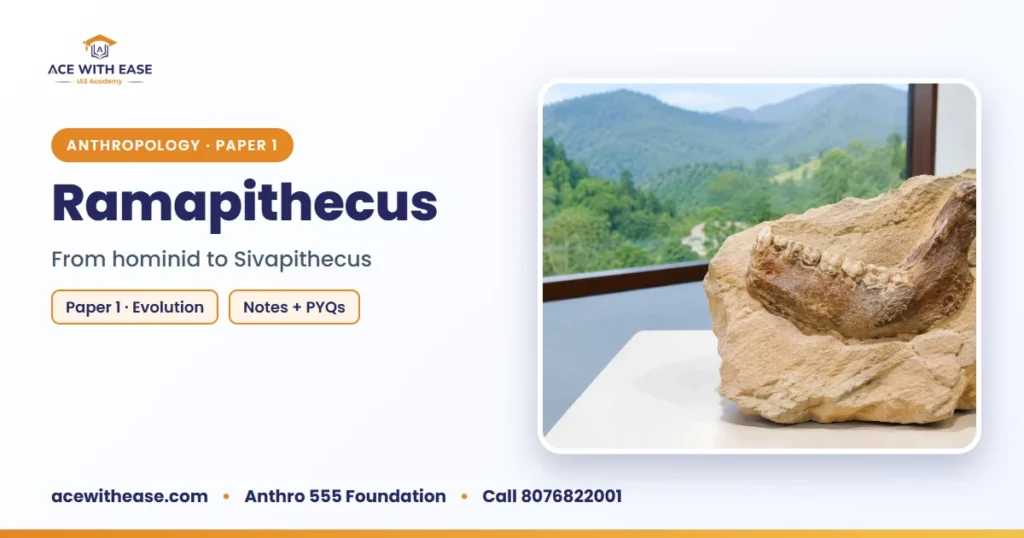
Ramapithecus: Discovery, Features and Why It Is Now Sivapithecus
⏱ 5 min read | ~1046 words
Ramapithecus is the classic example of how a fossil can rise to fame and then lose its status. For about twenty years it was taught as the first hominid, the earliest ancestor of humans. Today it is classified as part of Sivapithecus, an ancestor of the orangutan. For UPSC Anthropology Paper 1, examiners ask about its discovery, features, the debate over its status and its relationship with Sivapithecus and Dryopithecus.
Discovery of the Ramapithecus Fossil
- In 1932, G. Edward Lewis, a Yale graduate student, found a fragment of an upper jaw in the Siwalik Hills near Haritalyangar (now in Himachal Pradesh, India).
- He named it Ramapithecus brevirostris, after the Hindu god Rama (“Rama’s ape”).
- The fossils come from Miocene deposits about 14 to 8 million years old.
- Similar jaws were found in Pakistan (Potwar Plateau), Turkey, Hungary and China. Kenyapithecus, found by Louis Leakey at Fort Ternan, Kenya (1961), was also once grouped with it.
Why Was Ramapithecus Called a Hominid?
In the 1960s Elwyn Simons and David Pilbeam re-studied the fragments and argued that Ramapithecus was the earliest hominid, on the basis of the jaw and teeth (no skull or limb bones were known):
| Feature | What it suggested |
|---|---|
| Parabolic (rounded) dental arcade | Human-like, unlike the U-shaped arcade of apes |
| Small canines, no large diastema | Reduced canine use, human-like |
| Thick enamel on molars | Grinding tough food on open ground, like later hominins |
| Short face (“brevirostris” means short snout) | Less prognathic than apes |
On this basis, Ramapithecus was placed at the base of the human family tree, with the human-ape split pushed back to about 14-15 million years.
Why Ramapithecus Lost Its Hominid Status
1. Molecular evidence
In 1967 Vincent Sarich and Allan Wilson compared blood proteins and estimated that humans and African apes split only about 5 million years ago. If this was right, a 14-million-year-old Ramapithecus could not be a human ancestor.
2. New fossils
From the late 1970s, Pilbeam’s team in Pakistan found more complete material. A partial face (specimen GSP 15000, about 8 million years old, described in 1982) showed clear orangutan-like features: a concave face, narrow space between the eyes and the shape of the incisors and palate. The “parabolic” arcade of the early fragments was shown to be a reconstruction error.
3. Ramapithecus and Sivapithecus are the same
Researchers concluded that these fossils were the smaller (probably female) individuals of Sivapithecus, a Miocene ape already known from the Siwaliks. By the rules of naming, the older name Sivapithecus has priority, so Ramapithecus is no longer used as a separate genus.
Ramapithecus and Dryopithecus
Dryopithecus is a Miocene ape from Europe (first found in France in 1856), with a typical ape “Y-5” molar cusp pattern. Older textbooks drew a line from a Dryopithecine stock to Ramapithecus and then to humans. Today Dryopithecus is seen as a European ape, possibly related to the African great ape line, while Sivapithecus (including Ramapithecus) belongs to the Asian orangutan line (Pongo).
| Dryopithecus | Ramapithecus / Sivapithecus | |
|---|---|---|
| Region | Europe | South Asia (Siwaliks), also Turkey, China |
| Age | About 12-9 million years | About 13-8 million years |
| Teeth | Thin enamel, Y-5 molar pattern | Thick enamel, smaller canines |
| Present view | European Miocene ape | Ancestor or relative of the orangutan |
Ramapithecus Brain Capacity
Students often search for the the brain capacity of this ape, but no Ramapithecus skull vault has ever been found; the fossils are jaws and teeth. So its brain size is not known, and any figure quoted in guides is a guess based on body size. Say this honestly in an answer; examiners value accuracy.
Significance of Ramapithecus in Human Evolution
- It shows how fragmentary fossils can mislead, and why complete specimens matter.
- It is a textbook case of molecular anthropology correcting fossil-based interpretations.
- It highlights the Siwalik Hills of India as one of the richest Miocene ape sites in the world.
- The true earliest hominins are now sought in Africa, about 7-4 million years ago (Sahelanthropus, Orrorin, Ardipithecus).
Timeline of the Ramapithecus Debate
| Year | Event |
|---|---|
| 1932 | G.E. Lewis finds the first jaw fragment at Haritalyangar, Siwalik Hills |
| 1961 | Louis Leakey describes Kenyapithecus from Fort Ternan, Kenya, later linked with Ramapithecus |
| 1960s | Elwyn Simons and David Pilbeam argue Ramapithecus is the earliest hominid |
| 1967 | Sarich and Wilson’s molecular clock puts the human-ape split at about 5 million years |
| Late 1970s-1982 | More complete Sivapithecus fossils from Pakistan (including GSP 15000) show orangutan features |
| 1980s onward | Ramapithecus is merged into Sivapithecus and removed from the human line |
The Siwalik Hills: India’s Fossil Treasure
The Siwalik (Shivalik) Hills along the foothills of the Himalaya, from Jammu and Himachal Pradesh to Pakistan’s Potwar Plateau, hold one of the richest records of Miocene and Pliocene mammals in the world: apes such as Sivapithecus and Gigantopithecus, early elephants, horses and giraffes. For Anthropology Paper 2 (prehistoric India), you can mention the Siwaliks both for these ape fossils and for the later Soanian stone-tool culture of the Palaeolithic.
Official Sources and Further Reading
Frequently Asked Questions
Who discovered Ramapithecus?
G. Edward Lewis discovered the first Ramapithecus fossil in the Siwalik Hills of India in 1932.
Is Ramapithecus a human ancestor?
No. It was once thought to be the first hominid, but it is now classified as Sivapithecus, a relative of the orangutan.
What is the relationship between Ramapithecus and Sivapithecus?
Ramapithecus fossils are now considered the smaller, probably female, individuals of Sivapithecus. The name Sivapithecus has priority.
What is the age of Ramapithecus?
The fossils come from Miocene deposits about 14 to 8 million years old.
What is the brain capacity of Ramapithecus?
It is not known, because only jaws and teeth have been found, not a skull vault.
What is the difference between Ramapithecus and Australopithecus?
Ramapithecus (now Sivapithecus) was a Miocene ape from about 14-8 million years ago, known only from jaws and teeth and related to the orangutan. Australopithecus lived about 4.2-2 million years ago in Africa, walked upright and is an ancestor of the genus Homo.
Preparing for Anthropology Optional?
- Anthro 555 Foundation 2027 with Shiva Teja Sir (live)
- Anthropology Optional Test Series 2027
- Book a free demo class
Related notes

 Anthropology Paper 1 Notes · 23 Nov 2026
Chromosomal Aberrations: Structural and Numerical Types with Examples
 Anthropology Paper 1 Notes · 23 Nov 2026
Theories of Evolution: Lamarckism, Darwinism, Mutation Theory and the Synthetic Theory
 Anthropology Paper 1 Notes · 23 Nov 2026
Radiocarbon Dating (C14 Method): Principle, Half-Life, Limits and Other Dating Methods