
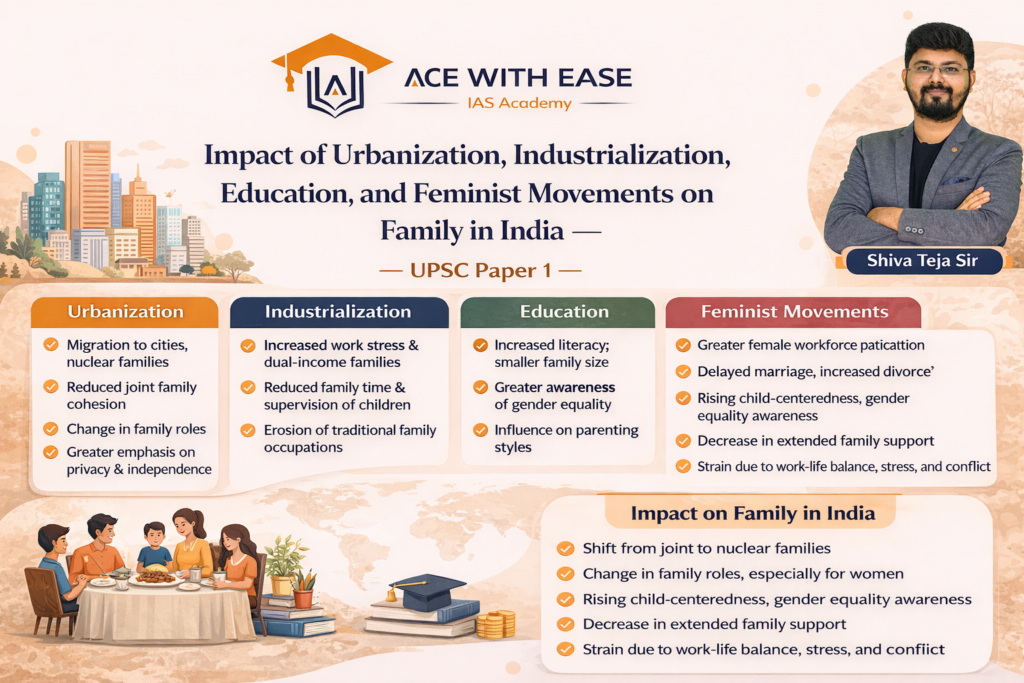
Impact of Urbanization, Industrialization, Education, and Feminist Movements on Family in India — UPSC Paper 1
⏱ 18 min read | ~3801 words
In 1950, most Indian families lived together—three generations under one roof, one kitchen, one god. By 2024, India has more nuclear families than joint families, more single-member households than ever before, and marriage rates are declining in its cities. What happened? The short answer: urbanization, industrialization, education, and feminist movements. For UPSC Anthropology Paper 1, these four forces of change and their impact on the Indian family are a core topic—and one that frequently appears in previous year questions.
If you’ve been studying the joint family and wondering why it’s changing so dramatically, this blog answers that question. These four processes are not independent forces—they’re deeply interconnected. Industrialization drives urbanization. Urbanization creates employment opportunities that require migration and mobility. Education changes people’s values and aspirations. And feminist movements directly challenge the patriarchal foundations that made the traditional joint family system work. Understanding how these four forces interact is essential for UPSC preparation.
The Interplay of Four Forces of Change
These four processes are often discussed together on UPSC papers because they are fundamentally interrelated and reinforce each other. Understanding their connection is as important as understanding each one individually.
Industrialization requires workers to leave villages and migrate to cities where factories, businesses, and jobs are concentrated. Urbanization, in turn, creates new social environments where traditional family structures face pressure. Both urbanization and industrialization create economic situations where education becomes crucial for survival and advancement. And as education spreads—particularly among women—it exposes people to new ideas, including feminist critiques of patriarchal family structures. This creates a cycle of change that accelerates itself.
Let’s examine each force in detail.
Impact of Urbanization on Family: Structure, Roles, and Functions
Urbanization and Family Structure (Demographic Changes)
Declining fertility rates are one of the most dramatic demographic consequences of urbanization. In rural, agrarian societies, children are economic assets—they can work in fields from an early age, they help with household labor, and they provide old-age security for parents. In urban environments, children are economically expensive. They require schooling, healthcare, and cost money without generating income until late teens or adulthood. Additionally, urban housing is expensive and crowded, creating less space for large families.
The result? Urban families have fewer children than rural families. This demographic shift is visible even within single countries—rural parts of India have total fertility rates of 2.5-3.0 children per woman, while urban areas have rates of 1.4-1.8. Mumbai, Delhi, and Bangalore have fertility rates lower than many developed countries.
Nuclear families become the norm in urban settings. With fewer children and smaller incomes concentrated in nuclear units, urban couples often choose to live separately from the extended family. This choice is partly economic and partly practical—it’s easier for a young couple earning wages to maintain their own household than to negotiate roles and authority within a larger joint family structure.
Physical separation of kin members increases dramatically. When a son gets a job in Delhi, he might stay there for years without his entire family moving. When a daughter marries, she might settle in a different city entirely. Even though emotional bonds persist, the daily interaction and pooling of resources that characterize joint families breaks down. Geographic distance makes co-residence impossible and makes the common kitchen impossible.
New household forms emerge that were rare or nonexistent in rural India. Young people sharing PG accommodations form households without kinship bonds. Live-in partners challenge traditional marriage norms. Single-person households increase as individuals delay or forgo marriage. Divorced or separated individuals set up independent households. These forms were virtually unknown in traditional Indian joint family systems.
Divorce and remarriage rates increase in urban areas. While marriage remains important, the stakes of staying in an unhappy marriage decrease in urban settings where family honor and reputation carry less weight, and where a divorced woman can theoretically support herself through wage labor. Urban women increasingly have the economic independence to exit unhappy marriages—something that was virtually impossible in joint family systems where a woman had no property rights or earning opportunities.
Urbanization and Family Roles
The separation of workplace from home transforms gender roles. In agricultural economies, the family was a unit of production. A woman managed the household AND participated in agricultural labor—planting, harvesting, caring for livestock. Men’s and women’s labor were complementary and visible within the family economy. In urban industrial settings, income-earning happens outside the home in offices, factories, and shops. Typically, the male member becomes the primary income earner while the female member manages the household (though this pattern is changing with women’s education).
This division of labor had unintended consequences. Women became economically dependent on male earners. Their work, though essential for family functioning, became invisible—it wasn’t counted as “labor” and produced no independent income. This economic dependence weakened women’s bargaining power within the family.
Nuclear family structure weakens the authority of household heads. In joint families, the patriarch had absolute authority—he controlled property, distributed resources, arranged marriages, and made major decisions. In nuclear families, a young couple makes many decisions together. If they disagree, they can’t appeal to a patriarch’s authority because they’re the authority in their own household. Additionally, young people in urban areas are often more educated than their parents, which shifts who is seen as having valuable knowledge and expertise.
The state increasingly takes over family functions. In rural India, the joint family provided education (through apprenticeship), healthcare (through home remedies and traditional practices), childcare (through grandmothers and aunts), and old-age care (younger generations supported elders). Urban societies developed public schooling, hospitals, daycare centers, nursing homes, and social security systems. As these institutions expanded, family members no longer had to provide these services. A child goes to school rather than receiving education at home. An elderly parent goes to a nursing home rather than being cared for by sons and daughters-in-law.
Women increasingly enter the urban workforce, particularly in service sectors, education, and increasingly, professional sectors. As women become wage earners, their role within the family shifts. A woman earning an independent income has more bargaining power regarding household decisions, child-rearing practices, and her own life choices. The shift from housewife to working professional is more dramatic in urban areas where job opportunities for women exist.
Single-parent families increase as a result of rising divorce rates and also because of migration patterns that separate spouses. A woman whose husband migrates for work might remain with children in the village—technically a single-parent household. An urban mother raising children alone after divorce or separation represents a family form that traditional society could barely conceive of, given that a woman alone had no means of survival.
Impact of Industrialization on Family: Economic and Social Disruption
Industrialization is different from urbanization, though they’re often linked. Urbanization is about concentration of population in cities. Industrialization is about the factory system and wage labor replacing household-based production. The impact on the family is profound.
The Fundamental Economic Transformation
Industrialization separates workplace from home. This sounds simple, but it’s revolutionary. In agrarian society, the family was the unit of production. The father, mother, sons, daughters, and sometimes relatives all worked together—in fields, in craft production, in trade. The family unit produced the goods and services that the family consumed. Profit (if any) was reinvested in the family business.
In industrial society, workers leave home to work in factories, offices, or shops where they earn wages. They don’t own the means of production; they rent their labor. The family is no longer a unit of production—it’s a unit of consumption. Family members work for different employers in different sectors. They pool wages to buy what the family needs—food, shelter, clothing.
This shift fundamentally changed family dynamics. The father was no longer the master of a family production enterprise; he was a wage laborer. The mother was no longer a productive partner in family work; she managed the household on the wages the father brought home. Children were no longer apprentices learning the family trade; they were dependents who had to be educated to find their own jobs.
Industrialization Promotes Migration and Breaks Up Joint Families
Industrial employment is rarely located in ancestral villages. Factories are built near cities, near coal mines, near ports, near raw materials. A young man seeking work must migrate from the village. If he wants to bring his family, he has to leave the joint family compound.
Even when he finds work, he might live in an industrial town where housing is expensive and space is limited. His brothers might find work in different cities. His sons might get education and find jobs elsewhere. The extended family, which was an advantage in agrarian society (more hands to work more land), becomes a disadvantage in industrial society (more dependents competing for limited housing and school places).
Specialist Agencies Replace Family Functions
The state and market institutions take over functions that families once performed. This is subtle but profound.
Education: In agrarian society, children learned by doing—they learned farming from fathers, household management from mothers, caste occupations from family craft specialists. Schools didn’t exist or were available only to upper castes and wealthy families. Now, school education is compulsory, universal (in theory), and factory work requires literate workers who can follow instructions and keep records. Families can no longer educate children at home.
Healthcare: In traditional society, illness was treated at home by mothers or local healers using traditional medicine. Death often occurred at home. Birth was managed by midwives within the family. Now, hospitals and clinics treat illness. Doctors are professionals outside the family. Childbirth happens in hospitals. Old age diseases are treated in nursing homes. Death increasingly happens in hospitals rather than at home surrounded by family.
Childcare: In joint families, grandmothers, aunts, and older siblings cared for young children. Now, as women work outside the home, daycare centers and schools provide childcare. As a result, children spend less time with extended family and more time with paid caregivers and in institutional settings.
Old-age care: In joint families, sons and daughters-in-law cared for aging parents. Now, as families disperse geographically and as adult children have demanding careers, elderly parents increasingly live alone or in nursing homes rather than with children.
Changing Status of Work and Worker Identity
In agrarian society, identity was primarily based on kinship, caste, and community. A person was “Sharma’s son from the weaving community in this village.” In industrial society, identity is increasingly based on occupation and employer. A person is “an engineer at TCS” or “a doctor at Apollo Hospitals.” This shift in identity means that people’s social status and self-image is determined less by family and caste and more by their individual achievement and occupation.
I.P. Desai and Allen Ross, studying Indian industrial families, found that industrial families showed lower unity and cohesion than agricultural families. They attributed this to:
– Occupational diversity (family members work in different industries, making economic cooperation difficult)
– Different work schedules and routines (members aren’t home at the same times)
– Individualism promoted by modern education and wage labor
– Reduced economic interdependence (each earner gets their own wage)
The Generation Gap and Value Conflict
J.P. Singh’s analysis of industrial families highlights how industrialization creates a values gap between generations. The older generation, born in pre-industrial agrarian society, values family unity, respects authority, and sees hard work as a means to family prosperity. The younger generation, educated in schools and living in cities, values individual achievement, questions authority, and sees hard work as a means to personal success and mobility.
Older parents expect sons to contribute earnings to the joint family fund and to obey family decisions about marriage and career. Younger sons expect to earn wages for their own nuclear family and to make personal choices about whom to marry and what career to pursue.
Life expectancy has also increased due to industrialization and modern medicine. More old-aged people live longer, creating financial burden on working-age children. A father supporting aging parents while raising his own children faces difficult trade-offs. Preference for neolocal (own-home) nuclear households increases because young couples feel they cannot afford to support extended kin.
Impact of Education on Family: Individualism and Mobility
Education is transformative not just economically but culturally and ideologically. It reshapes how people think, what they value, and what they aspire to.
Education Promotes Individualism
Formal schooling, particularly modern educational systems, emphasizes individual achievement. Students compete for grades individually. Success is measured by individual test scores. Educational advancement depends on individual ability and effort. This is fundamentally different from traditional learning where knowledge was transmitted within families and communities, and where learning was a collective enterprise.
As people become educated, they develop aspirations separate from family traditions and expectations. An educated child might aspire to become a doctor or engineer rather than inherit father’s agricultural land or caste occupation. She might aspire to work in a professional career rather than marry and manage a household. He might aspire to start his own business rather than work in the family trade.
Education Liberates Women
Educated women are less willing to accept subordinate roles within patriarchal family structures. This is one of the most important consequences of education spread and is directly tied to feminist movements.
An uneducated woman might accept the authority of her mother-in-law because she has no alternative livelihood and depends on the joint family for survival. An educated woman has options. She can find employment. She can support herself. She understands her legal rights. She’s exposed to ideas of equality through education. She’s less willing to endure subordination.
Education delays marriage age, particularly for women. Highly educated women marry later than less educated women, reducing the time spent in childbearing years and increasing the time available for careers and personal development. This delay in marriage means fewer children and more economic independence.
Education Increases Occupational Mobility
Education makes people geographically mobile. A village farmer stays in the village, but a village boy with school education can migrate to the city for college. A college graduate can find job opportunities in any city or country. This migration for education often leads to permanent migration for jobs.
Each generation becomes more mobile than the previous. The grandfather farmed ancestral land. The father migrated to the city for a job but sent money home. The grandson lives in a metro city and visits the ancestral village once a year. The bond to ancestral place and family weakens with each generation.
Education Erodes Traditional Authority
I.P. Desai noted that modern education works against joint family unity in two main ways:
First, by increasing occupational mobility—educated individuals leave home communities, disrupting the continuity of residence and the daily cooperation that held joint families together.
Second, by promoting individualism—education teaches people to question, to think critically, to evaluate alternatives. A child taught to ask “why?” in school will ask “why should I obey father without question?” at home. A person exposed to diverse philosophies and worldviews through education is less likely to accept automatic deference to family authority based on age and generation.
Impact of Feminist Movements on Family: Challenging Patriarchy
Feminist movements represent a direct ideological challenge to the patriarchal foundations of both nuclear and joint families. While the first three forces (urbanization, industrialization, education) were somewhat “accidental” disruptions to traditional families, feminist movements constitute intentional, conscious critique and challenge to the family structure itself.
Feminist Critique of the Family
Margaret Barston and other feminist scholars argued that the family is fundamentally exploitative, particularly of women. Women perform essential domestic labor—cooking, cleaning, childcare, elder care—without pay, without recognition, and often without choice. This unpaid labor is essential for the capitalist economy to function (workers need to be fed, clothed, and rested to work), yet it’s invisible and undervalued.
Marxist-feminists analyzed the family as an ideological conditioning device that reproduces patriarchal capitalist relations across generations. The family teaches women to be submissive, to value men’s work more than their own, and to see their reproductive and domestic role as “natural” rather than socially constructed. In this view, the family is not a natural, universal institution but a political structure that maintains women’s subordination.
Friedrich Engels, in his influential work “The Origin of the Family, Private Property, and the State” (1884), argued that the monogamous family emerged historically to ensure men’s control over women’s reproductive capacity. Men wanted to be sure that property passed to their biological heirs, not to children of uncertain paternity. Therefore, monogamy and strict control of women’s sexuality were instituted to serve men’s economic interests. In Engels’ analysis, the family is a property institution and form of women’s control, not a natural or universal institution.
Specific Feminist Challenges to the Family
3. Single parenthood became increasingly acceptable and visible. More women chose to have children without marriage. More women managed single parenthood after divorce or separation. Rather than being seen as social failure, single motherhood came to be seen as a valid choice and family form.
4. Sharing of parenting and household duties shifted from exceptional to expected. The idea that fathers should share in childcare and housework, and that this is normal rather than unusual, is a feminist achievement. It challenges the division of labor where the father’s role is earning and the mother’s role is domestic.
5. Women’s economic independence reduces the compulsion of marriage as an economic necessity. When women can earn independent income, they marry for love and companionship, not for survival. And they can leave marriages that don’t work, something that was impossible when they had no means of livelihood.
Kathleen Gough and the Feminist Challenge to Family Universality
Kathleen Gough, a feminist anthropologist, made a crucial contribution by challenging the assumption that the nuclear family is universal. She argued that the only truly universal relationship is the mother-child bond—all human societies have mothers who nurture dependent children. Everything else—marriage, paternity, fatherhood, the family—varies significantly across cultures and is culturally constructed.
This insight is powerful because it undermines the naturalization of patriarchal families. If the nuclear family isn’t universal, if the patriarchal father isn’t universal, then these forms aren’t “natural”—they’re social creations that can be changed and reformed.
📌 UPSC Previous Year Questions
- These topics appear regularly on UPSC Anthropology Paper 1. Here are representative questions:
- Q: “Discuss the impact of urbanization and feminist movement on family in Indian society.” (2013, 2016)
- Q: “What is the impact of urbanization and industrialization on family structure in India?” (2014, 2017, 2019)
- Q: “Explain the impact of feminist movements on the universality of marriage and family structure.” (2020)
- Q: “What are the changing trends in the Indian family? Discuss the role of education, urbanization, and values in these changes.” (2019)
- Q: “Analyze how industrialization has transformed family relationships and roles in Indian society.” (2018, 2021)
- Q: “Discuss the concept of ‘nuclearization’ of Indian families. Is this an inevitable consequence of modernization?” (2015, 2022)
❓ Frequently Asked Questions