
Kinship in Anthropology: Consanguinity, Affinity, and Degrees of Kinship for UPSC Paper 1
⏱ 15 min read | ~3186 words
In modern cities, we often say “family is everything.” But what counts as family? Blood relatives? In-laws? Close friends who feel like family? Anthropologists have been wrestling with exactly this question—and the concept of kinship is their answer. For UPSC Anthropology Paper 1, kinship is one of the most consistently tested topics, appearing in nearly every examination cycle. Understand it right, and questions worth 20+ marks become not just manageable, but genuinely interesting.
The beauty of kinship as a topic is that it sits at the intersection of biology and culture, nature and society. It’s universal—every society has a kinship system—yet infinitely varied in how it operates. A child born in Mumbai might inherit property through her father’s line, while a child born 500 kilometers away in Kerala inherits through her mother. This is not biology; it’s anthropology. And this is what makes kinship so crucial for your UPSC preparation.
What is Kinship? Understanding the Core Concept
At its simplest, kinship refers to the network of social relationships based on, or believed to be based on, birth and marriage. But anthropologists have refined this definition over more than a century of study. Let’s look at how the discipline’s giants have understood kinship.
Claude Lévi-Strauss, the structural anthropologist, argued that kinship is fundamentally the social recognition of biological relationships. It’s not about biology per se, but about how societies recognize and give meaning to biological connections. Lewis Henry Morgan, working in the 1870s, went further—he saw kinship as the most basic social bond, the very foundation upon which all social organization rests. A. R. Radcliffe-Brown, the functionalist patriarch, defined kinship as any socially recognized relationship based on birth or marriage, and he emphasized that kinship systems must be understood in their social context, not as isolated categories.
Consider J. Beattie’s definition: “Kinship refers to the system of social relationships which are based on, or modeled on, the relations of parents and children and other close relatives.” Notice the phrase “modeled on”—this is crucial. A kinship system extends the logic of parent-child relationships to create a wider network of social bonds. This is why a man might call his father’s brother “father” in some societies; the relationship is modeled on the biological father-child tie, even though there’s no biological paternity involved.
The key insight is this: kinship is simultaneously biological and social. The same biological relationship—say, a man’s mother’s brother—can be treated in radically different ways across cultures. In some societies, he is a warm, indulgent relative. In others, he is a formal authority figure. In yet others, he may be a potential rival or threat. This variation is not accidental; it reflects different kinship principles operating in different societies.
The History of Kinship Studies: From Morgan to Lévi-Strauss
To truly understand kinship concepts, you need to know where they came from. The history of kinship studies is a history of anthropological thinking itself.
Lewis Henry Morgan published Systems of Consanguinity and Affinity of the Human Family in 1871, a monumental work that surveyed kinship terminology across hundreds of societies. Morgan made a crucial distinction: some societies have descriptive kinship terminology, where each relative gets a unique term (English uses this system—we distinguish between brother and cousin, uncle and aunt). Other societies have classificatory kinship terminology, where many relatives are grouped under a single term (a man might call both his biological father and his father’s brother by the same word—”father”). This distinction, which Morgan identified, remains one of the most important in kinship studies.
In the 1940s, A. R. Radcliffe-Brown revolutionized kinship studies by insisting that kinship must be analyzed not as an abstract system of terms, but as a set of social relationships and obligations embedded in a functioning society. He moved the discipline away from comparative word-lists toward what he called structural-functional analysis. Kinship, he argued, is about how societies organize themselves and function—not merely about terminology.
E. E. Evans-Pritchard’s groundbreaking study of the Nuer of Sudan demonstrated how kinship and descent principles create a society’s political system. Among the Nuer, lineage segments generate a form of political organization called the segmentary lineage system. At different levels of genealogical distance, kinship obligations activate different political groupings—showing that kinship is not separate from politics but foundational to it.
Meyer Fortes, studying the Tallensi of Ghana, made a critical distinction between descent (the jural, legally binding principle through which group membership is transmitted) and filiation (the intimate, personal relationship between parent and child, which may cut across descent lines). This distinction has been absolutely central to kinship theory ever since. For instance, in patrilineal societies, a man inherits property and status through his father (descent), but his relationship with his mother and her brother (filiation) may provide emotional support and alternative resources.
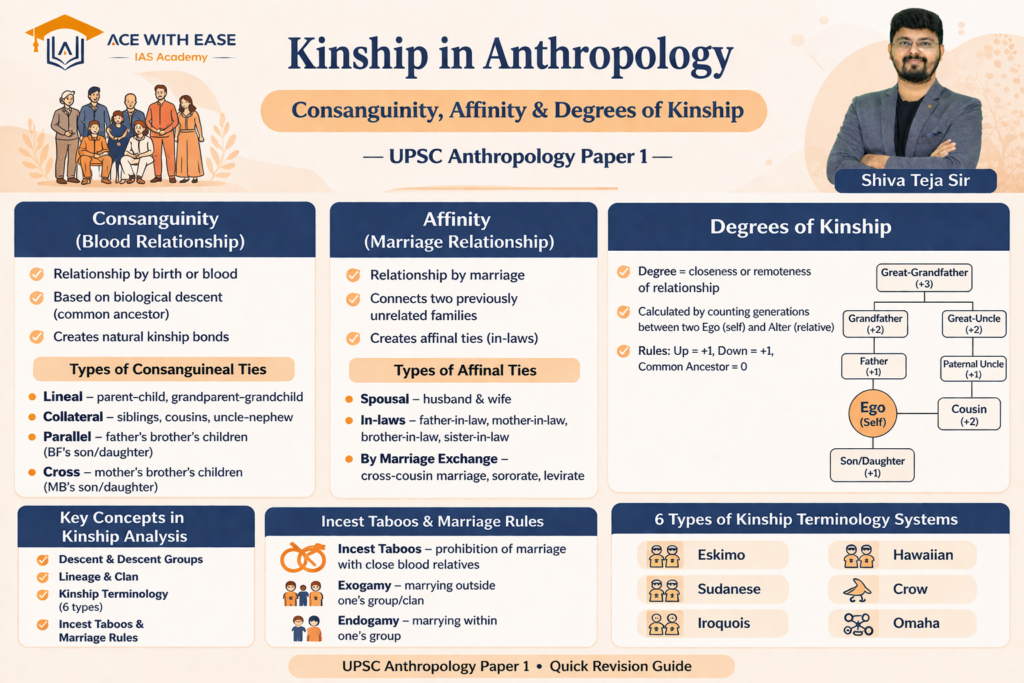
George P. Murdock’s monumental comparative work Social Structure (1949) analyzed kinship systems across 250 societies and identified six major kinship terminology systems (Eskimo, Hawaiian, Iroquois, Crow, Omaha, and Sudanese). This classification, still taught in anthropology courses worldwide, provides a framework for understanding kinship terminology patterns and their correlation with descent systems.
Claude Lévi-Strauss, in his magnum opus The Elementary Structures of Kinship (1949), argued that kinship systems are fundamentally about regulating marriage and creating exchange between groups. His alliance theory proposed that exogamy (marriage outside one’s group) is a universal rule that forces societies to exchange women and create bonds between groups. While later criticized, Lévi-Strauss’s work brought kinship into a truly structural light—kinship is not just a system of categories, but a dynamic system of circulation and exchange.
In the 1950s, Edmund Leach challenged the rigid formalism of earlier approaches. He argued that kinship meanings are not fixed and universal, but depend heavily on context and individual choice. Kinship, Leach insisted, cannot be mechanically diagrammed and universally applied; it requires deep ethnographic understanding of specific societies.
Why Kinship Matters: Three Essential Reasons
For UPSC preparation, it’s important to understand why kinship is such a fundamental concept in anthropology. There are three interconnected reasons that make this topic indispensable.
First, kinship is simultaneously biological and cultural. While all human societies face biological realities—women bear children, men impregnate women, people are born and die—no two societies organize kinship identically. This tension between universal biology and cultural variation is at the heart of anthropology itself. Kinship shows us how culture works: it takes biological facts and transforms them into meaningful social relationships.
Second, kinship is the primary organizing principle in pre-state societies. In societies without formal government institutions—no police, no courts, no bureaucracy—kinship is the language through which all social organization happens. It governs who can marry whom, how resources are distributed, who resolves disputes, and who goes to war. To understand a pre-state society, you must understand its kinship system.
Third, even in modern state societies, kinship remains crucial. We like to think of ourselves as modern and beyond kinship, but family connections still determine access to property, influence, and opportunity. In Indian politics, kinship networks remain extraordinarily important—consider how many political dynasties exist in India’s electoral system. Kinship, in this sense, is never merely “traditional”; it’s always relevant.
Consanguinity and Affinity: The Two Pillars of Kinship
Now let’s get into specifics. All kinship relationships fall into two fundamental categories, and understanding the distinction between them is absolutely essential for UPSC.
Collateral consanguineal kin are related through a common ancestor but not in a direct line. Your sibling, cousin, uncle, and aunt are collateral kin. You might have the same grandparent, but your connection to your cousin goes through that shared grandparent—not directly. The term “collateral” comes from the Latin for “side-by-side,” capturing the lateral nature of these relationships.
Affinal kin are relatives connected by marriage, not blood. When you marry, your spouse becomes affinal kin to you. Your spouse’s parents, siblings, and cousins become affinal kin. An affinal relationship is created through marriage; there is no biological link. However, some affinal relatives may eventually become consanguineal through your children—your spouse’s sibling becomes the aunt or uncle of your children, creating a quasi-consanguineal tie.
Here’s a crucial point for UPSC: In Western societies, especially modern urban ones, we tend to privilege consanguineal (blood) ties as “real” kinship and treat affinal ties as secondary or more optional. But this is a cultural choice, not a universal truth. In many traditional societies—certainly in most of the tribal and caste-based societies that UPSC asks about—affinal relationships carry obligations and rights just as binding as consanguineal ones. Among the Nuer, affinal relationships govern cattle exchanges and political alliances as powerfully as descent does. In many Hindu castes, marriage establishes lifelong bonds between affinal families that rival consanguineal kinship in importance. The Nayars of Kerala maintain elaborate obligations toward affinal kin that shape property transfer and social obligations across generations.
The distinction between consanguinity and affinity is not just academic. It determines whom you can marry (typically, you cannot marry certain consanguineal relatives, but you might marry affinal relatives), how you inherit property, and what obligations you have toward different relatives. When UPSC asks you to explain the “kinship system” of a particular society, this consanguinity-affinity distinction is always fundamental to your answer.
Degrees of Kinship: The Expanding Network
Anthropologists have classified relatives into three degrees based on genealogical distance. While this might sound mechanical, it actually reveals something profound: kinship creates a vast, expanding network of social relationships.
Secondary kin are related to you through a primary kin. Your father’s brother, mother’s sister, brother’s wife, and sister’s husband are secondary kin. George Murdock identified 33 types of secondary kin across different kinship systems. The point is that these relatives are once-removed from your direct line; they are important and recognized, but typically with somewhat less intensity than primary kin. Yet in patrilineal societies like the Nuer, your father’s brother (paternal uncle) plays a crucial role in your upbringing and inheritance.
The significance of this three-degree classification is simple: kinship creates a vast network of social relationships. In a traditional pre-state society, virtually every person you interact with regularly is a kinship relative at some degree. This is how kinship functions as the organizing principle of society—it ties the entire community into a mesh of obligations, rights, and reciprocal relationships.
Robin Fox’s Four Universal Principles of Kinship
Now, here’s a question that has fascinated anthropologists: Are there any universal principles of kinship? Or is kinship entirely culturally relative?
Robin Fox, in his influential work Kinship and Marriage (1967), proposed that beneath all the cultural variation, four universal biological and social principles generate all kinship systems. These are worth memorizing for UPSC:
1. Women bear children. This is a biological fact. Because women bear children and spend time nursing them, they are always the primary caretaker in infancy. This biological reality shapes kinship everywhere. The mother-child bond is recognized in every society because it is rooted in nine months of pregnancy and extended lactation.
2. Men impregnate women. Another biological fact. The asymmetry between male and female reproductive roles creates a biological distinction that all societies must account for. Male contribution is less visible than female contribution, which has consequences for how paternity is treated—sometimes closely monitored, sometimes less significant depending on the society’s kinship principles.
3. Men usually exercise control over women’s sexuality, reproductive capacity, and labor. This is a social and political fact, not a biological necessity—but it is nearly universal. In most societies (though not all), men control women’s sexuality and reproductive capacity through marriage, kinship rules, and property systems. This power asymmetry shapes kinship rules everywhere. Inheritance systems, marriage payments, divorce rights, and custody of children are all shaped by this asymmetry.
4. Primary kin do not mate with each other (the incest taboo). This is the universal negative rule. Every society prohibits reproduction between certain primary relatives—though exactly which relatives varies somewhat. Some societies extend the incest taboo to include cousins or other collaterals, while others do not.
The first three principles explain why kinship systems exist and why they differ across societies. Different societies resolve these universal challenges—who cares for children, how is male impregnation organized, who controls women’s labor and reproduction—in different ways.
The fourth principle, the incest taboo, is particularly important. Lévi-Strauss argued that the incest taboo is the founding rule of culture itself. Why? Because the prohibition on mating with primary kin forces marriage to occur outside one’s immediate family. This creates exchange between groups, creates alliances between families, and thus creates society. The incest taboo is, in Lévi-Strauss’s view, what transforms a collection of families into a society. For UPSC, remembering this connection between the incest taboo and the origin of culture and society is valuable.
Why Kinship Rules Matter in Traditional Societies
To understand kinship’s importance, consider its social functions. In traditional, pre-state societies, kinship is not one institution among many—it is the primary institution through which all others are organized.
Marriage rules are kinship rules. When a society says “you must marry outside your clan” or “you must marry a cross-cousin,” it is enforcing a kinship rule. These rules structure the entire society, determining which families will be allied through marriage and which will be rivals.
Inheritance follows kinship. Who gets the land? Who gets the house, the cattle, the ritual objects? In traditional societies, these are determined by kinship position—whether through patrilineal descent, matrilineal descent, or some other principle. Among the Nuer, cattle wealth passes through patrilineal descent. Among the Nayars, property passes through the matrilineage.
Kinship determines ritual obligations. Who performs funeral rites? Who presides over naming ceremonies? Who brings offerings at harvest? In societies with ancestor veneration—most of Asia, much of Africa—these ritual obligations are governed by kinship position. The senior male in a patrilineage often performs rituals for deceased lineage members.
In stateless societies, kinship IS the political system. Lineages and clans handle conflict resolution. They allocate resources. They organize defense against outsiders. There is no government bureaucracy; instead, elders of different lineages or clans make decisions. Political authority is understood through kinship—the senior lineage elder has authority because of his position in the descent group.
Even in modern societies like India, kinship networks remain crucial. They provide social support in times of crisis. They facilitate access to jobs and economic opportunity. They shape electoral politics—consider the prevalence of family dynasties in Indian politics. While Indian law and bureaucracy nominally govern society, kinship networks remain structurally important in practice.
📌 UPSC Previous Year Questions
- The following questions have appeared on UPSC Civil Services Anthropology Paper 1:
- Q: “Define kinship and describe its importance in social organization.” (2019)
- Q: “Distinguish between consanguineal and affinal kin with examples from your area of study.” (2016)
- Q: “What are Robin Fox’s universal principles of kinship? Discuss their relevance for understanding kinship systems.” (2015)
- Q: “Trace the history of kinship studies in anthropology from Morgan to Lévi-Strauss.” (2013)
- Q: “Explain the concept of primary, secondary, and tertiary kin.” (2017)
- Q: “How do kinship terminology systems differ from kinship behavior? Illustrate with examples.” (2014)
❓ Frequently Asked Questions


