The Joint Family in India: Understanding Features, Changes, and Domestic Groups for UPSC Anthropology
⏱ 12 min read | ~2636 words
Chacha, chachi, dada, dadi, cousins running around, one kitchen, everyone under the same roof—this is how many of us grew up hearing about the Indian family. For generations, the joint family was the defining image of Indian domestic life. But here’s the question that keeps showing up on UPSC papers: is it really disappearing? And more importantly for your exam, how does it actually differ from the Western nuclear family? And what exactly is the difference between a household and a domestic group?
The truth is, the joint family and its transformation is one of the most fascinating topics in UPSC Anthropology Paper 1 because it connects so many threads—kinship systems, economics, urbanization, and cultural change—all into one concept. In this blog, we’ll break down the joint family in India, explore what makes it unique, understand why scholars like Iravati Karve defined it the way they did, and see how the structure keeps changing yet persisting in modern India.
What Exactly Is a Joint Family?
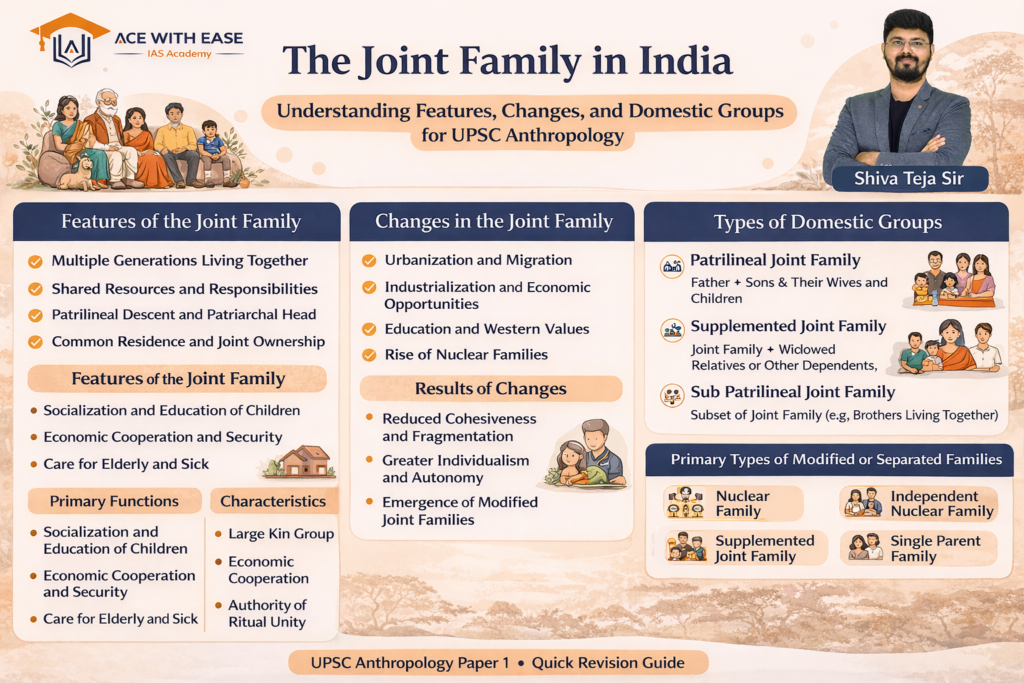
Let’s start with the basics. A joint family is simply a group of several related families—what we call conjugal or nuclear families—living together as one unit. If you think about it as an expansion of the nuclear family (parents and children), the joint family extends this in two directions simultaneously.
First, it extends horizontally. Imagine a man and his brothers—each has his own wife and children. All of them, along with the wives and children, might live under one roof. That’s horizontal extension—siblings and their spouses and children.
Second, it extends vertically. In many households, you’ll also find grandparents, and sometimes great-grandparents, living with their children, grandchildren, and even great-grandchildren. That’s vertical extension—multiple generations stacked together.
So the joint family is really about pooling labor, resources, and living space across multiple related nuclear families. It’s not just romantic nostalgia about big families—it’s a functional economic and social unit with specific rules and roles.
The Hindu Joint Family: Iravati Karve’s Landmark Definition
If you’re preparing for UPSC, you’ll definitely encounter Iravati Karve’s definition of the Hindu joint family. Karve, a pioneering anthropologist who studied Indian families extensively, gave the most widely cited definition that forms the foundation for how we understand the joint family in India.
According to Karve, a joint family is one where:
1. Members live under one roof (common residence). This isn’t just about living in the same house—it’s about sharing the same physical space, which creates daily interaction and interdependence. You can’t escape each other; you have to negotiate and cooperate every single day.
2. They have a common hearth (common kitchen). This is probably the single most powerful symbol of joint family unity in Karve’s definition. Eating together from the same kitchen means sharing the same food, which in Indian culture has deep significance—it represents accepting the same ritual status, the same moral code, and belonging to the same group. The common kitchen is so important that its breakdown is often the first sign that a joint family is fragmenting.
5. They worship a common deity (common religious life). Family rituals, prayers, and religious ceremonies are shared. Ancestor worship is a collective activity. This religious unity reinforces the sense of being one family bound by sacred ties, not just economic ones.
Building on Karve’s definition, scholars like K.M. Kapadia and I.P. Desai added one more crucial criterion: generation depth—a true joint family should have at least three generations present. This distinguishes a joint family from an extended family that might have uncles and aunts but not grandparents.
Key Characteristics of the Hindu Joint Family
Let’s explore what makes the Hindu joint family distinctive by looking at its major characteristics:
Common Residence
All members live together, at least for significant periods of their life. In traditional Indian society, even if a member had to travel for business or education, they were expected to return home. The house was the center of family life and identity.
Common Kitchen and Shared Meals
The common kitchen is more than a place where food is prepared—it’s the economic and social hub of the joint family. A mother-in-law managing the kitchen holds significant authority. The ritual of eating together reinforces bonds in ways that are hard to overstate in Indian culture.
Large Size and Multi-generational Structure
Joint families are typically large, with multiple generations. You might find a patriarch, his wife, his adult sons with their wives and children, unmarried daughters, and even elderly parents or unmarried brothers of the patriarch.
Principle of Seniority
Authority in the joint family follows age and generation. The eldest male (usually the patriarch) has the final say in major decisions. Women gain authority as they age—a mother-in-law often wields significant power within the household. Respect for elders is built into the very structure of the family.
Mutual Obligations and Support
Each member has clear obligations to others. Sons must support aging parents. Daughters-in-law must respect mothers-in-law. The family doesn’t abandon members who cannot earn. A widow, an orphaned child, or an elderly person without other resources finds support within the joint family system.
Mutual Rights
Just as there are obligations, there are rights. A member has the right to food, shelter, and basic necessities from the common pool. A son has inheritance rights. These are not discretionary gifts but recognized rights.
Economic Unit and Unit of Consumption
The joint family functions as both a production and consumption unit. All production is pooled, and all consumption comes from the common fund. This creates efficiency and reduces inequality—everyone eats, everyone is clothed, everyone is sheltered according to the family’s means.
Religious Functions and Common Worship
Family rituals—births, marriages, deaths, festivals—are celebrated together. Ancestors are worshipped collectively. This religious unity adds a sacred dimension to family ties.
Strong Affinal and Consanguineal Bonds
The joint family includes both blood relations (consanguineal) and relations through marriage (affinal). A daughter-in-law is not just married to a son but becomes part of the family structure. Her children are the family’s children. This integration of affinal relatives into the core family structure is distinctive.
The Hindu Joint Family and the Caste System
You can’t really understand the Hindu joint family without understanding its deep entanglement with the caste system. The joint family is always linked to caste identity. The family unit itself functions as the basic unit through which caste rules are maintained and transmitted.
Through the joint family, caste rules of purity and pollution are enforced. Endogamy (marriage within caste) is maintained through family control of marriage decisions. Occupational specialization by caste is transmitted through the family. A caste occupation, like weaving or leather work, is taught within the family and passed from father to son.
Interestingly, tribal societies function differently. Tribal communities often don’t have the classical joint family pattern found in Hindu society. Among many tribal groups, residence is more often neolocal (the newly married couple sets up their own household) or nuclear. However, economic cooperation and sharing of resources still extend to wider kin groups, even if they don’t live under one roof.
The Cyclical Theory of Joint and Nuclear Families
Here’s where things get interesting for UPSC preparation. For a long time, sociologists assumed that modernization = nuclearization. The idea was simple: as societies industrialize and urbanize, joint families disappear and are replaced by nuclear families. This was seen as an inevitable, one-way process.
But scholars like Kapadia (1956), Gore (1968), and especially A.M. Shah (1970) challenged this linear model with empirical research. They found something surprising: a cyclical pattern.
Here’s how it works: A newly married couple might set up their own nuclear household (often after the groom migrates for work or the couple can’t afford to live with the joint family). They have children. As the children grow and marry, the household expands—daughters-in-law move in, grandchildren are born—and the household becomes joint. Then, as the children migrate for their own jobs or education, some members move away, and the household contracts back to nuclear or partial family form.
So joint and nuclear families aren’t opposed forms competing for dominance. They’re cyclical phases that a household might move through over time. A household that is nuclear today might be joint tomorrow and nuclear again after that.
Milton Singer (1968) made another important observation about urban industrial families in cities: what he called compartmentalization. Even among modern professionals in cities, people maintain traditional joint family values and obligations at home while operating in a modern, individualistic way at the workplace. They send remittances to villages, support extended family members, and return home for major family occasions.
This challenges the simple assumption that urbanization destroys joint family bonds. It shows that traditional and modern can coexist.
Household vs. Family: A Critical Distinction for UPSC
This is a concept that appears regularly on UPSC papers, and students often get confused. Let’s clarify it.
A household is fundamentally a residential unit. According to Haviland (2003), a household is the basic group of people who inhabit a common dwelling and share a common food supply. The household is a functional unit for:
– Economic production and consumption
– Inheritance and property management
– Child-rearing and socialization
– Providing shelter and basic needs
Here’s the key difference: A household may or may not be a family.
Think about it. A group of students sharing an apartment forms a household—they share a common dwelling and common food expenses. But they’re not a family. They might become friends, but they don’t have kinship bonds.
Conversely, a family may not be a household. Imagine a joint family whose members live in different cities—one branch in Delhi, another in Mumbai, another in Bangalore. They don’t share a common residence, but they still maintain strong family bonds. They inherit from common property. They receive economic transfers from wealthier members. They gather for major family occasions. They are still functionally a family even though they’re not a household.
Domestic Groups: Beyond Family and Household
The term domestic group is yet another concept in anthropology that overlaps with but is distinct from both family and household. According to Smith’s definition, a domestic group is simply a group of people who habitually share a common dwelling and a common food supply—which sounds similar to a household. But the emphasis is different.
Meyer Fortes, another influential anthropologist, defined domestic groups as essentially family and housekeeping groups that band together to supply their members with material and cultural resources. He emphasized that members are kinsmen—they’re related by blood (agnates) or through marriage (affines). So unlike a household of students, a domestic group is fundamentally kinship-based.
In contemporary functional schools of anthropology, domestic groups are seen as functional variants of the family structure—different forms that families take in different societies to accomplish similar survival and socialization functions.
A practical example: Among the Muria Gond of Chhattisgarh (a tribal group in India), young people traditionally lived in youth dormitories called ghotuls. These were domestic groups that served specific socialization functions—they trained young people in adult roles and responsibilities outside the nuclear or joint family structure. The ghotul was a domestic group because its members shared a dwelling and food and had kinship-like obligations to each other, even though they weren’t all related by blood or marriage.
📌 UPSC Previous Year Questions
- The joint family, household, and domestic groups concepts appear frequently on UPSC Anthropology Paper 1. Here are some representative previous year questions:
- Q: “Discuss the main features of the Hindu joint family. How is it changing in contemporary India?” (2019)
- Q: “Distinguish between household and domestic group with suitable examples.” (2022)
- Q: “Discuss the concept of household and domestic groups in the context of Indian society.” (2018)
- Q: “What is the cyclical theory of joint family? Explain its relevance to understanding modern Indian families.” (2016)
- Q: “Explain Iravati Karve’s definition of the Hindu joint family. What are the implications of her criteria for understanding family change?” (2015)
❓ Frequently Asked Questions