
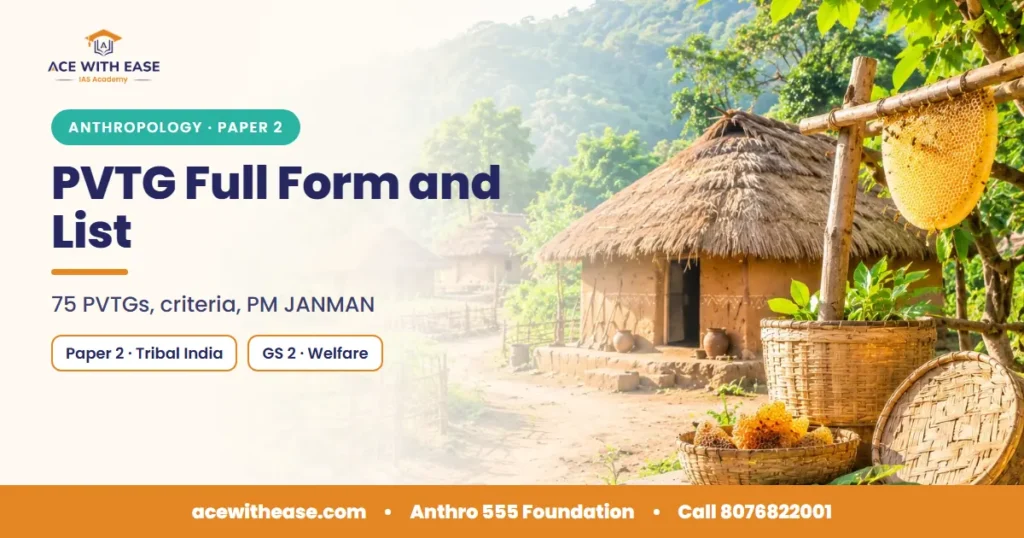
PVTG Full Form, Criteria and List of 75 PVTGs in India
⏱ 7 min read | ~1491 words
The PVTG full form is Particularly Vulnerable Tribal Groups. These are the most marginalised among India’s Scheduled Tribes, and a favourite topic for UPSC Anthropology Paper 2, GS Paper 2 and Prelims. This note covers the history of the term, the four PVTG criteria, the PVTG list by state (including Telangana and Andhra Pradesh), the PM JANMAN mission and the main issues.
What Is a PVTG?
Among the 700-plus Scheduled Tribes, some communities are far more vulnerable than others: they are small, isolated, use very simple technology and have very low literacy. The Government of India identifies these as PVTGs so they can get special, focused development plans.
History: From PTG to PVTG
- The Dhebar Commission (1960-61) noted large inequalities within Scheduled Tribes and pointed to the most backward groups.
- During the Fifth Five Year Plan, the government created a separate category of Primitive Tribal Groups (PTGs).
- In 1975, 52 groups were identified; more were added later, and by 1993 the number reached 75.
- In 2006, the name was changed from PTG to PVTG, because the word “primitive” was seen as derogatory.
PVTG Criteria
A tribe is identified as a PVTG if it shows:
- Pre-agricultural level of technology (hunting, gathering, shifting cultivation)
- Low level of literacy
- Economic backwardness
- A declining or stagnant population
These four PVTG criteria are a common Prelims question. Note that PVTG is an administrative category inside the ST list; it is not a constitutional term.
PVTG vs Scheduled Tribe
| Point | Scheduled Tribe (ST) | PVTG |
|---|---|---|
| Legal basis | Constitutional: Article 366(25) and Article 342 | Administrative category created by the Government of India |
| Who notifies | The President, for each state or UT; changes need an Act of Parliament | Identified by the Government of India; now handled by the Ministry of Tribal Affairs |
| Criteria | Lokur Committee (1965): primitive traits, distinctive culture, geographical isolation, shyness of contact, backwardness | Pre-agricultural technology, low literacy, economic backwardness, declining or stagnant population |
| Number | Over 700 communities | 75 groups |
| Benefits | Reservation, Fifth/Sixth Schedule protection, TSP / DAPST | All ST benefits plus CCD plans, PM JANMAN and habitat rights |
Every PVTG is a Scheduled Tribe, but only the most vulnerable STs are PVTGs. This one-line distinction is worth writing in any answer on the PVTG criteria.
PVTG List in India: Key Facts
- There are 75 PVTGs in 18 states and 1 Union Territory (Andaman and Nicobar Islands).
- Odisha has the largest number (13 PVTGs).
- Some PVTGs number only a few dozen or a few hundred people, such as the Great Andamanese and the Sentinelese.
PVTG List: Important Examples by State
| State / UT | Important PVTGs |
|---|---|
| Andaman and Nicobar Islands | Great Andamanese, Onge, Jarawa, Sentinelese, Shompen |
| Odisha (13) | Bondo, Dongria Kondh, Juang, Kutia Kondh, Lanjia Saura, Hill Kharia, Birhor, Chuktia Bhunjia, Didayi, Lodha, Mankirdia, Paudi Bhuyan, Saura |
| Andhra Pradesh and Telangana (12, listed together) | Chenchu, Bodo Gadaba, Gutob Gadaba, Bondo Poroja, Khond Poroja, Parengi Poroja, Dongria Khond, Kutia Khond, Kolam, Konda Reddi, Konda Savara, Thoti. In Telangana the main ones are Chenchu, Kolam, Konda Reddi and Thoti |
| Jharkhand | Asur, Birhor, Birjia, Hill Kharia, Korwa, Mal Paharia, Parhaiya, Sauria Paharia, Savar |
| Madhya Pradesh / Chhattisgarh | Baiga, Bharia, Sahariya (MP); Abujh Maria, Kamar, Pahari Korwa (Chhattisgarh) |
| Tamil Nadu / Kerala | Toda, Kota, Kurumba, Irula, Paniyan, Kattunayakan (TN); Cholanaikkan, Kadar, Kurumba, Koraga (Kerala) |
| Karnataka | Jenu Kuruba, Koraga |
| Gujarat / Rajasthan / Maharashtra | Kathodi, Kotwalia, Padhar, Siddi, Kolgha (Gujarat); Sahariya (Rajasthan); Katkari, Kolam, Madia Gond (Maharashtra) |
Government Schemes for PVTGs
PM JANMAN
- Pradhan Mantri Janjati Adivasi Nyaya Maha Abhiyan (PM JANMAN) was launched on 15 November 2023 (Janjatiya Gaurav Divas).
- Budget of about ₹24,000 crore over three years, through 9 ministries.
- It targets PVTG habitations with 11 critical interventions: pucca houses, roads, piped water, electricity, mobile medical units, hostels, Anganwadis, multipurpose centres, mobile connectivity and livelihood support.
Other support
- Development of PVTGs scheme (Ministry of Tribal Affairs): states prepare Conservation-cum-Development (CCD) plans.
- Special provisions under the Forest Rights Act: habitat rights for PVTGs (Section 3(1)(e)). The Baiga of Madhya Pradesh were among the first to receive habitat rights.
- Priority in the Tribal Sub Plan / DAPST allocations.
Issues Faced by PVTGs
- Loss of land and forest because of mining, dams, wildlife reserves and tourism.
- Health crises: malnutrition, anaemia, tuberculosis and high infant mortality.
- Very low literacy and difficulty getting documents such as caste certificates and Aadhaar.
- Contact and isolation dilemma for groups like the Jarawa, Sentinelese and Shompen; the Great Nicobar project has raised concern about the Shompen.
- Data gap: the Census does not publish PVTG-wise data, so planning is weak; the list itself has not been revised for decades.
Way Forward
- Review the PVTG list and criteria with fresh field data.
- Publish PVTG-wise data in the next Census.
- Implement habitat rights under the Forest Rights Act.
- Culturally sensitive health and education, using the community’s own language.
- Plan with the community, not for it, following the spirit of Nehru’s Tribal Panchsheel.
Committees and Milestones to Remember
| Body / event | Relevance to PVTGs |
|---|---|
| Dhebar Commission (1960-61), appointed under Article 339 | Pointed out wide inequality among STs and the need for special attention to the least developed groups |
| Lokur Committee (1965) | Laid down the criteria for identifying Scheduled Tribes, the base category within which PVTGs are later picked out |
| Fifth Five Year Plan | Created the PTG category and micro-projects under the Tribal Sub Plan |
| 2006 | PTG renamed PVTG |
| Forest Rights Act, 2006 | Section 3(1)(e) recognises habitat rights of PVTGs |
| 2023 | PM JANMAN launched for PVTG habitations |
Case Study: The Chenchus of Telangana and Andhra Pradesh
The Chenchus are the PVTG most often quoted from South India. They live in the Nallamala hills on both sides of the Krishna river, in Telangana and Andhra Pradesh.
- Economy: traditionally food gatherers and hunters, they depend on honey, tubers and minor forest produce such as gum and medicinal plants.
- Classic ethnography: Christoph von Fürer-Haimendorf’s The Chenchus: Jungle Folk of the Deccan (1943) made them a textbook example of a food-gathering band society. Haimendorf also studied the Konda Reddis in The Reddis of the Bison Hills.
- Present issues: life inside a tiger reserve, debates over relocation, malnutrition and dependence on forest produce prices.
- Administration: an ITDA at Srisailam works specially for the Chenchus, an example of the PVTG focus within the Tribal Sub Plan.
The Kolams of Adilabad are another good example. They practised shifting cultivation on hill slopes and speak Kolami, a Dravidian language, and they appear in the PVTG list of both Telangana and Maharashtra.
How UPSC Asks About PVTGs
- Prelims: PVTG full form, the four criteria, the state with the most PVTGs, and matching a PVTG to its state.
- GS Paper 2: schemes such as PM JANMAN and why PVTG welfare lags behind.
- Anthropology Paper 2: problems of PVTGs, their identification, and case studies of specific groups such as the Chenchus, Jarawa or Baiga.
- Linkages: PVTGs and the Forest Rights Act, isolation versus integration, and the role of the state in protecting small groups.
Answer-Writing Tips: Structuring a 15-Mark Answer
- Introduction: PVTG full form, the 75 groups and the four criteria in two or three lines.
- Body part 1: the main problems, each backed by a named group (Shompen and the Great Nicobar project, Chenchus and the tiger reserve).
- Body part 2: government response: CCD plans, PM JANMAN, habitat rights under the FRA.
- Body part 3: gaps, such as old criteria, no Census data and weak implementation.
- Conclusion: a way forward rooted in Nehru’s Tribal Panchsheel and community-led planning.
Read this with our notes on the Sixth Schedule of the Indian Constitution for the wider picture of tribal administration, or join our Anthropology Optional coaching to practise such answers with Shiva Teja Sir.
Frequently Asked Questions
What is the full form of PVTG?
PVTG stands for Particularly Vulnerable Tribal Groups.
How many PVTGs are there in India?
75 PVTGs in 18 states and the Union Territory of Andaman and Nicobar Islands.
What are the criteria for identifying PVTGs?
Pre-agricultural level of technology, low literacy, economic backwardness and a declining or stagnant population.
Which state has the highest number of PVTGs?
Odisha, with 13 PVTGs.
Which PVTGs live in Telangana?
Chenchu, Kolam, Konda Reddi and Thoti.
When was the term PTG changed to PVTG?
In 2006, the Government of India renamed Primitive Tribal Groups as Particularly Vulnerable Tribal Groups.
Is PVTG a constitutional category?
No. Scheduled Tribes are defined in the Constitution (Article 366(25), Article 342), but PVTG is an administrative category created by the Government of India within the ST list.
Who are the Chenchus?
The Chenchus are a PVTG of the Nallamala forests in Telangana and Andhra Pradesh, traditionally food gatherers, made famous in anthropology by Christoph von Fürer-Haimendorf’s 1943 study.
Preparing for Anthropology Optional?
- Anthro 555 Foundation 2027 with Shiva Teja Sir (live)
- Anthropology Optional Test Series 2027
- Book a free demo class
Related notes

 Anthropology Paper 2 Notes · 23 Nov 2026
Sixth Schedule of the Indian Constitution: Autonomous District Councils, Powers and Ladakh
 Anthropology Paper 2 Notes · 23 Nov 2026
PESA Act 1996: Full Form, Key Provisions, States and Implementation
 Anthropology Paper 2 Notes · 23 Nov 2026
Tribal Sub Plan (TSP): Origin, Strategy, DAPST and Criticism