
Australopithecus: Species, Lucy, Features and Place in Human Evolution
⏱ 5 min read | ~1047 words
Australopithecus is the group of early hominins that proves our ancestors walked upright long before their brains grew large. For UPSC Anthropology Paper 1, you must know the main species (afarensis, africanus and the robust forms), Lucy, the bipedal features and their phylogenetic position. This note covers each point with exam-ready tables.
Meaning and First Discovery
Australopithecus means “southern ape”. The name was given by Raymond Dart in 1925 to the Taung Child, a skull found in a limestone quarry at Taung, South Africa, in 1924. Dart named it Australopithecus africanus and argued it walked upright because its foramen magnum sat far forward. Most scientists rejected him at first; only after Robert Broom’s finds in the 1930s-40s and the later East African discoveries was Australopithecus accepted as a human ancestor.
The genus lived in Africa from about 4.2 to 2 million years ago, in the Pliocene and early Pleistocene.
Main Species of Australopithecus
| Species | Age (million years) | Key sites | Points to remember |
|---|---|---|---|
| A. anamensis | 4.2-3.8 | Kanapoi, Allia Bay (Kenya) | Earliest species; clear bipedal tibia |
| A. afarensis | 3.9-2.9 | Hadar (Ethiopia), Laetoli (Tanzania) | Lucy; Laetoli footprints; brain about 380-550 cc |
| A. africanus | 3.3-2.1 | Taung, Sterkfontein, Makapansgat (South Africa) | Taung Child; “Mrs Ples”; gracile form |
| A. sediba | about 1.98 | Malapa (South Africa) | Mix of ape-like and Homo-like traits; found 2008 |
| Paranthropus robustus | 2.0-1.0 | Kromdraai, Swartkrans (South Africa) | Robust; named by Robert Broom (1938) |
| Paranthropus boisei | 2.3-1.2 | Olduvai Gorge (Tanzania) | “Zinjanthropus” found by Mary Leakey (1959); huge molars |
Australopithecus Afarensis and Lucy
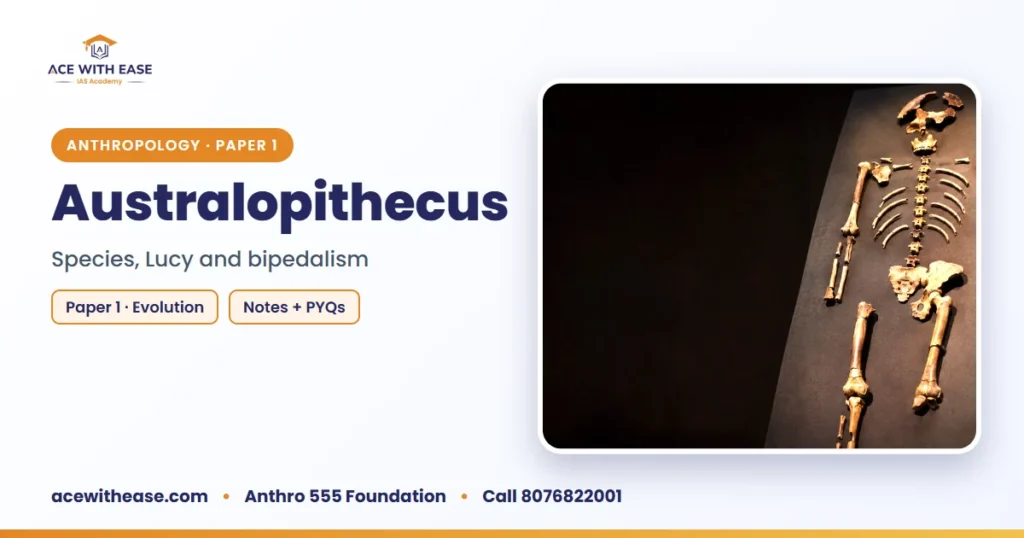
Lucy (specimen AL 288-1) is the most famous Australopithecus afarensis fossil. She was discovered in 1974 by Donald Johanson and Tom Gray at Hadar, Ethiopia. About 40% of one skeleton survived, dated to about 3.2 million years. Lucy stood a little over one metre tall.
- Her pelvis and knee joint show she walked upright on two legs.
- Her long arms and curved finger bones show she could still climb trees.
- Her small brain shows that bipedalism came before brain enlargement, the single most important lesson of Australopithecus.
- The Laetoli footprints (about 3.66 million years old, found by Mary Leakey’s team in 1978) confirm a human-like upright gait in the same species.
Australopithecus Africanus
Australopithecus africanus is the South African gracile species. Besides the Taung Child, important fossils are “Mrs Ples” (STS 5) from Sterkfontein, found by Robert Broom in 1947, and the nearly complete “Little Foot” skeleton. Compared with afarensis it has a slightly larger brain (about 420-500 cc) and smaller canines.
Gracile vs Robust Australopithecines
| Feature | Gracile (afarensis, africanus) | Robust (robustus, boisei) |
|---|---|---|
| Skull | Lighter, rounded | Heavy, with a sagittal crest for huge chewing muscles |
| Face | Projecting, smaller cheeks | Broad, flat, “dished” face with flaring cheekbones |
| Teeth | Moderate molars | Very large molars and premolars, small front teeth |
| Diet | Mixed | Tough plant foods (hence the name “nutcracker man” for boisei) |
| Fate | Likely ancestors of Homo | Extinct side branch (now genus Paranthropus) |
Anatomical Features: Ape and Human Mix
Human-like (bipedal) traits
- Foramen magnum placed forward, under the skull.
- Short, broad, bowl-shaped pelvis.
- Valgus (angled) knee bringing the feet under the body.
- S-shaped spine and an arched foot.
- Reduced canines, no large canine-premolar honing complex.
Ape-like traits
- Small brain: about 380-550 cc (Australopithecus brain capacity is close to a chimpanzee’s).
- Prognathic face.
- Long arms relative to legs, curved fingers.
- Rapid, ape-like growth pattern in children.
Did Australopithecus Make Tools?
Traditionally, tool making began with Homo habilis and the Oldowan industry (about 2.6 million years ago). But Lomekwi 3 in Kenya has stone tools dated to about 3.3 million years, older than any known Homo. They may have been made by an Australopithecus or by Kenyanthropus. Mention this in answers as recent evidence.
Phylogenetic Status of Australopithecus
Most anthropologists place A. afarensis close to the common ancestor of two lines: one leading to the robust Paranthropus species (an extinct side branch) and one leading to Homo. The exact link from Australopithecus to Homo is still debated: A. africanus, A. garhi and A. sediba have all been proposed. For UPSC, write that Australopithecus is the stage of “bipedal apes”, ancestral to the genus Homo, and draw a simple branching diagram rather than a straight ladder.
Australopithecus vs Homo habilis
UPSC often asks how Australopithecus differs from the first members of our own genus. This comparison table is ready to use:
| Feature | Australopithecus | Homo habilis |
|---|---|---|
| Age | About 4.2-2 million years | About 2.4-1.4 million years |
| Brain size | About 380-550 cc | About 550-700 cc |
| Face and jaw | Projecting face, large molars | Less projecting face, smaller molars |
| Locomotion | Bipedal but still good climbers | Bipedal, with some climbing ability |
| Tools | Possible (Lomekwi), not regular | Oldowan stone tools; name means “handy man” |
| Key discoverers | Raymond Dart, Robert Broom, Donald Johanson | Louis and Mary Leakey, Olduvai Gorge (1960s) |
How to Write a 15-Mark Answer on Australopithecus
- Introduction: meaning of the name, Dart’s 1925 discovery, time range.
- Body 1: table of species (anamensis, afarensis, africanus, sediba, robust forms).
- Body 2: bipedal vs ape-like features, with a simple labelled sketch of the pelvis or skull.
- Body 3: gracile vs robust comparison and the phylogenetic tree.
- Conclusion: significance: bipedalism came before the large brain; recent finds (Lomekwi tools, sediba) keep the debate alive.
Official Sources and Further Reading
Frequently Asked Questions
What is the brain capacity of Australopithecus?
About 380 to 550 cc, depending on the species. That is close to a chimpanzee and about one third of a modern human brain.
Who discovered Lucy, and where?
Donald Johanson and Tom Gray discovered Lucy (AL 288-1, Australopithecus afarensis) at Hadar in Ethiopia in 1974. She is about 3.2 million years old.
What is the difference between Australopithecus afarensis and africanus?
A. afarensis is the older East African species (3.9-2.9 million years, Lucy). A. africanus is the younger South African species (3.3-2.1 million years, Taung Child), with a slightly larger brain and smaller canines.
What are robust australopithecines?
Species with heavy skulls, sagittal crests and very large molars, adapted to tough plant food: P. robustus, P. boisei and P. aethiopicus. Most experts now place them in the genus Paranthropus.
Why is Australopithecus important in human evolution?
It shows that upright walking appeared millions of years before the brain became large, and it links the apes to the genus Homo.

 Anthropology Paper 1 Notes · 23 Nov 2026
Chromosomal Aberrations: Structural and Numerical Types with Examples
 Anthropology Paper 1 Notes · 23 Nov 2026
Theories of Evolution: Lamarckism, Darwinism, Mutation Theory and the Synthetic Theory
 Anthropology Paper 1 Notes · 23 Nov 2026
Radiocarbon Dating (C14 Method): Principle, Half-Life, Limits and Other Dating Methods