
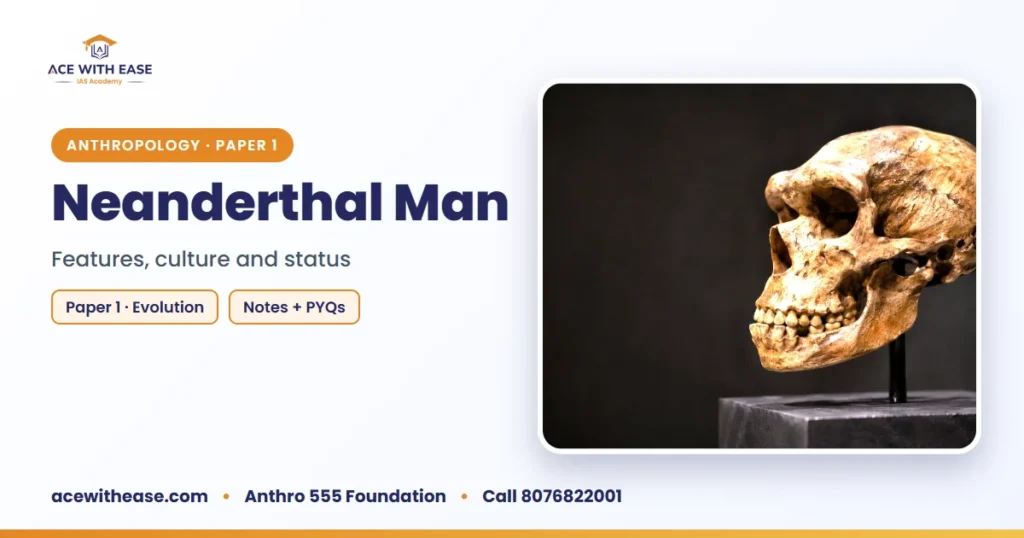
Neanderthal Man: Discovery, Features, Culture and Phylogenetic Status
⏱ 5 min read | ~1171 words
Neanderthal man (Homo neanderthalensis) is the best-known fossil human after Homo sapiens. For UPSC Anthropology Paper 1 (human evolution), questions on Neanderthals come back again and again: their features, the classic and progressive types, their Mousterian culture and, above all, their phylogenetic status. This note gives you all the Neanderthal man information you need in one place, in answer-ready form.
Neanderthal Man Meaning and Discovery
The name comes from the Neander Valley (Neanderthal) near Düsseldorf in Germany, where quarry workers found a skull cap and limb bones in the Feldhofer cave in 1856. In 1864 the geologist William King named the species Homo neanderthalensis. Earlier finds had already been made but not understood: a child’s skull at Engis, Belgium (1829-30) and an adult skull at Forbes’ Quarry, Gibraltar (1848).
So, in simple words, the Neanderthal man meaning is “the man of the Neander Valley”: an extinct human species that lived in Europe and western Asia during the later part of the Pleistocene, roughly 400,000 to 40,000 years ago, with the classic forms living about 130,000 to 40,000 years ago.
Distribution: Where Did Neanderthals Live?
- Western Europe: La Chapelle-aux-Saints, La Ferrassie, Le Moustier (France), Spy (Belgium), Neanderthal (Germany).
- Central and Eastern Europe: Krapina (Croatia), Ehringsdorf (Germany).
- West Asia: Tabun and Kebara (Israel), Shanidar (Iraq).
- Central Asia and Siberia: Teshik-Tash (Uzbekistan), Okladnikov and Denisova caves (Altai).
Physical Features of Neanderthal Man
Neanderthals were short, stocky and very muscular, a body built for the cold of the Ice Age (it fits Bergmann’s and Allen’s rules: a large, compact body with short limbs loses less heat).
| Region | Key features |
|---|---|
| Skull | Long, low and broad (dolichocephalic) skull vault; an occipital bun (chignon) at the back; a receding forehead |
| Face | Heavy, double-arched supraorbital torus (brow ridge); mid-facial prognathism (the face projects forward); a very large nasal opening |
| Jaw and teeth | No true chin; a retromolar space behind the last molar; large front teeth with heavy wear; taurodont molars (enlarged pulp cavity) |
| Body | Barrel-shaped chest, thick bones, short forearms and shins, strong muscle markings |
| Brain | Average cranial capacity about 1,450-1,500 cc (range about 1,200-1,750 cc) |
Neanderthal Man Cranial Capacity
A frequent UPSC one-liner: the Neanderthal man cranial capacity was on average slightly larger than that of modern humans (modern average about 1,350 cc). The La Chapelle-aux-Saints skull is often quoted at about 1,600 cc. A bigger brain does not mean they were “smarter”; it relates to their large, heavy bodies and possibly to a larger visual system.
Classic vs Progressive Neanderthals
Older textbooks divide Neanderthals into two groups. This classification still appears in UPSC answers, so learn it, but also mention the modern view.
| Point | Classic (Western European) | Progressive (Generalised) |
|---|---|---|
| Age | Late, during the last (Würm) glaciation | Earlier, during the last interglacial |
| Features | Extreme: heavy brow ridge, occipital bun, no chin, very robust | Less extreme, some modern-looking features: higher vault, smaller brow ridge |
| Examples | La Chapelle-aux-Saints, La Ferrassie, Le Moustier, Neanderthal, Spy | Krapina, Ehringsdorf, Steinheim, Tabun, Shanidar (some texts add Skhul) |
| Old interpretation | A specialised side branch, cut off by the cold | The line that led towards modern humans |
Culture: Mousterian Tool Tradition
- Tools: Neanderthals made the Mousterian tool industry of the Middle Palaeolithic (named after Le Moustier), with side scrapers, points and flakes made by the Levallois (prepared core) technique.
- Fire and shelter: They controlled fire, used caves and rock shelters, and wore some kind of clothing from hides.
- Burial: Deliberate burials are known from La Chapelle-aux-Saints, La Ferrassie and Shanidar. The Shanidar “flower burial” (pollen in the grave) is famous but debated.
- Care for the weak: Shanidar 1, an old man with a withered arm and head injuries, survived for years, which suggests the group cared for him.
- Symbolic behaviour: Eagle talon jewellery at Krapina and pigment use show that Neanderthals were capable of symbolic thought.
- Speech: A modern-looking hyoid bone from Kebara 2 and the shared FOXP2 gene suggest they could speak.
What Neanderthal DNA Tells Us
In 2010 a team led by Svante Pääbo published a draft Neanderthal genome. Pääbo received the 2022 Nobel Prize in Physiology or Medicine for this work. Two results matter for your answer:
- People living outside Africa today carry about 1-2% Neanderthal DNA, so Neanderthals and Homo sapiens interbred, mainly 50,000-60,000 years ago in West Asia.
- Some of these genes still affect modern humans, for example in immunity and skin, which is why people search “Neanderthal man today”: in a sense, a little of the Neanderthal lives on in us.
Why Did Neanderthals Disappear?
Neanderthals vanished about 40,000 years ago. No single cause is accepted; examiners like a balanced list:
- Competition with incoming Homo sapiens, who had better tools, wider social networks and larger groups.
- Rapid climate swings at the end of the Pleistocene.
- Very small, scattered populations with inbreeding (shown by ancient DNA).
- Absorption: part of the Neanderthal gene pool merged into Homo sapiens through interbreeding.
Phylogenetic Status of Neanderthal Man
This is the core UPSC question. There are three main views:
| View | What it says | Who / basis |
|---|---|---|
| Neanderthal phase | Neanderthals were a stage between Homo erectus and modern humans, everywhere | Aleš Hrdlička; old unilinear view |
| Pre-sapiens / separate species | A specialised side branch that went extinct; modern humans came from elsewhere (Out of Africa) | Out of Africa (replacement) model; Homo neanderthalensis |
| Subspecies of sapiens | Homo sapiens neanderthalensis, a regional form of our own species | Multiregional model |
Present consensus: Neanderthals and modern humans shared a common ancestor (often linked to Homo heidelbergensis) about 500,000-700,000 years ago. Neanderthals evolved in Europe and western Asia as a distinct lineage, while Homo sapiens evolved in Africa. When the two met, they interbred, so the best description is a closely related sister lineage, not our direct ancestor and not a completely separate dead end.
Official Sources and Further Reading
Frequently Asked Questions
What is the cranial capacity of Neanderthal man?
On average about 1,450-1,500 cc, with a range of roughly 1,200-1,750 cc. This is slightly larger than the modern human average of about 1,350 cc.
In which age did Neanderthal man live?
Neanderthals lived in the Middle and Upper Pleistocene, the Middle Palaeolithic in cultural terms, from about 400,000 to 40,000 years ago. Classic Neanderthals belong to the last glaciation.
What tools did Neanderthal man use?
They made Mousterian tools such as side scrapers and points, mostly using the Levallois prepared-core technique.
Are Neanderthals our ancestors?
Not directly. They are a sister lineage. But because they interbred with Homo sapiens, people outside Africa carry about 1-2% Neanderthal DNA.
Why is Neanderthal man important for UPSC Anthropology?
Neanderthals appear in Paper 1 under fossil evidence of human evolution. Questions ask for their features, distribution, culture and phylogenetic position, often as a 10 or 15 mark question.

 Anthropology Paper 1 Notes · 23 Nov 2026
Chromosomal Aberrations: Structural and Numerical Types with Examples
 Anthropology Paper 1 Notes · 23 Nov 2026
Theories of Evolution: Lamarckism, Darwinism, Mutation Theory and the Synthetic Theory
 Anthropology Paper 1 Notes · 23 Nov 2026
Radiocarbon Dating (C14 Method): Principle, Half-Life, Limits and Other Dating Methods