
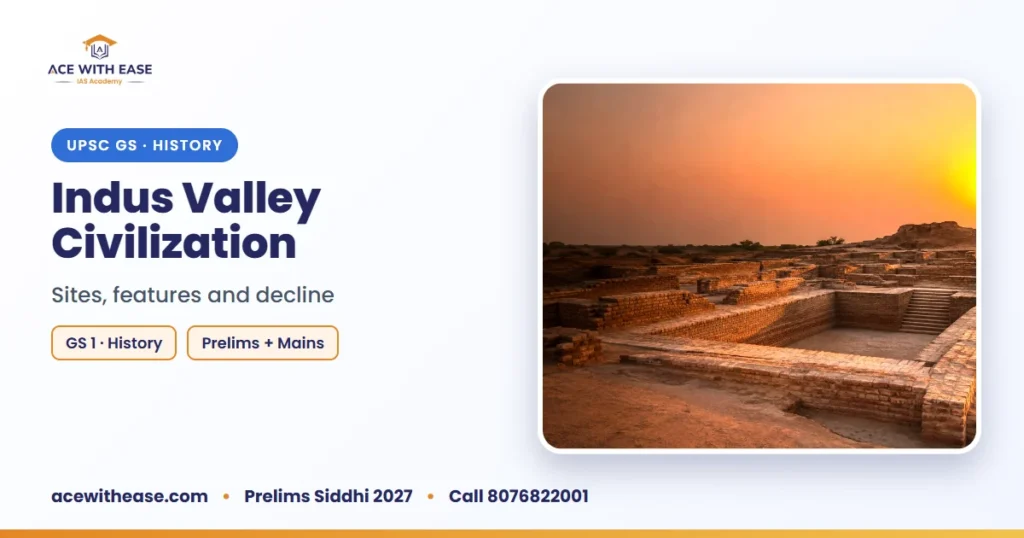
Indus Valley Civilization for UPSC: Phases, Important Sites, Features and Decline
⏱ 5 min read | ~1060 words
The Indus Valley Civilization (also called the Harappan Civilization) is India’s first urban civilization and a regular source of Prelims questions on sites, rivers and finds. It also matters for Mains GS I (art and culture) and for Anthropology Paper 2. This note covers the Indus Valley Civilization for UPSC: discovery, phases, a site-wise table, town planning, economy, religion, script and the theories of decline.
Discovery
- Harappa (on the Ravi, now in Pakistan’s Punjab) was excavated by Daya Ram Sahni in 1921.
- Mohenjo-daro (on the Indus, Sindh) was excavated by R.D. Banerji in 1922.
- Sir John Marshall, Director-General of the Archaeological Survey of India, announced the discovery of a new civilization in 1924.
- Because Harappa was the first site found, the culture is called the Harappan Civilization.
Time Period and Phases
| Phase | Approximate date | Features |
|---|---|---|
| Early Harappan | c. 3300-2600 BCE | Farming villages and small towns; regional cultures |
| Mature Harappan | c. 2600-1900 BCE | Planned cities, seals, script, long-distance trade: the peak |
| Late Harappan | c. 1900-1300 BCE | Decline of cities, shift to smaller rural settlements, more to the east and south |
These dates come mainly from radiocarbon dating. The civilization covered a huge area, about 1.3 million sq km, larger than ancient Egypt and Mesopotamia combined.
Geographical Extent
| Direction | Site | Region |
|---|---|---|
| Northernmost | Manda (also Shortughai, a trading outpost in Afghanistan) | Jammu (Chenab) |
| Southernmost | Daimabad | Maharashtra (Pravara) |
| Easternmost | Alamgirpur | Uttar Pradesh (Hindon) |
| Westernmost | Sutkagen-dor | Baluchistan (Dasht) |
Important Sites, Rivers and Key Finds
| Site | River / location | Important finds |
|---|---|---|
| Harappa | Ravi, Punjab (Pakistan) | Granaries, workers’ quarters, cemetery R-37, red sandstone male torso |
| Mohenjo-daro | Indus, Sindh (Pakistan) | Great Bath, Great Granary, bronze “Dancing Girl”, “Priest-King” bust, Pashupati seal |
| Lothal | Bhogava, Gujarat | Dockyard, bead-making factory, rice husk, fire altars |
| Kalibangan | Ghaggar, Rajasthan | Ploughed field (Early Harappan), fire altars, wooden furrow traces |
| Dholavira | Rann of Kutch, Gujarat | Water reservoirs, “signboard” inscription, three-part city; UNESCO World Heritage Site (2021) |
| Rakhigarhi | Ghaggar basin, Haryana | One of the largest Harappan sites; ancient DNA study published in 2019 |
| Chanhudaro | Indus, Sindh | No citadel; bead-making and craft centre |
| Banawali | Haryana | Toy plough, barley |
| Ropar | Sutlej, Punjab (India) | Burial of a dog with a human |
| Surkotada | Kutch, Gujarat | Bones claimed to be of a horse (debated) |
| Daimabad | Pravara, Maharashtra | Bronze chariot with figures |
Town Planning: The Defining Feature
- Cities were laid out on a grid pattern, with streets crossing at right angles.
- Most cities had a raised citadel (public buildings) to the west and a larger lower town (houses) to the east. Dholavira had three divisions.
- Standardised burnt bricks in the ratio 1:2:4 (thickness to width to length).
- An advanced covered drainage system, with drains from each house joining street drains; no other ancient civilization matched it.
- Houses had wells, bathing areas and courtyards; doors opened onto side lanes, not main streets.
Economy
- Agriculture: wheat and barley were main crops; also peas, sesame and mustard. Harappans were among the first to grow cotton. Rice is found at Lothal and Rangpur.
- Domestication: cattle, sheep, goats, buffalo and pigs. The horse is not clearly attested in the Mature phase.
- Crafts: bead making (carnelian), pottery (red ware with black designs), bronze casting (lost-wax method), seal making.
- Trade: internal and long-distance trade with Mesopotamia, where the Indus region was probably called “Meluhha”. Lothal’s dockyard and Shortughai show trade links.
- Weights and measures: standardised cubical weights in a binary system (1, 2, 4, 8, 16…) and a decimal system for larger weights.
Seals and Script
- Over 2,000 seals have been found, mostly square and made of steatite. The most common animal is the unicorn.
- The Harappan script has about 400 signs and is written mostly from right to left. It is still undeciphered, so we know Harappan society only through archaeology.
Religion and Beliefs
- Terracotta female figurines suggest worship of a Mother Goddess.
- The Pashupati seal from Mohenjo-daro shows a seated figure surrounded by animals, often linked to a proto-Shiva (an interpretation, not a proven fact).
- Worship of trees (pipal), animals (humped bull) and possibly fire (fire altars at Kalibangan and Lothal).
- No temples have been clearly identified; the dead were usually buried with pots and ornaments.
Indus Valley Civilization People
Who were the Harappans? Skeletal studies and the 2019 Rakhigarhi ancient DNA study suggest the Harappan people descended mainly from ancient South Asian hunter-gatherers mixed with populations related to early Iranian farmers. They were a diverse urban population of farmers, craftspeople, traders and administrators. For a deeper look, see our Anthropology note on Harappan people (coming soon).
Decline of the Indus Valley Civilization
| Theory | Proposed by / basis | Status |
|---|---|---|
| Aryan invasion | Mortimer Wheeler, based on skeletons at Mohenjo-daro | Largely rejected: no evidence of a massacre |
| Floods | Silt layers at Mohenjo-daro | Possible locally |
| Tectonic changes and river shifts | Changes in the course of the Indus; drying of the Ghaggar-Hakra | Widely discussed |
| Climate change | Weakening monsoon after about 2200 BCE (the “4.2 kiloyear event”) | Strong support from recent studies |
| Ecological degradation | Deforestation for brick kilns, overgrazing | Possible contributing factor |
| Decline of trade | Fall in trade with Mesopotamia | Contributing factor |
Today most historians speak of a gradual de-urbanisation caused by several factors together, especially climate change and shifting rivers, rather than a sudden collapse.
Official Sources and Further Reading
Frequently Asked Questions
Who discovered the Indus Valley Civilization?
Daya Ram Sahni excavated Harappa in 1921 and R.D. Banerji excavated Mohenjo-daro in 1922, under ASI Director-General John Marshall.
What is the period of the Indus Valley Civilization?
Roughly 3300-1300 BCE, with the mature urban phase between about 2600 and 1900 BCE.
Which is the largest Harappan site in India?
Rakhigarhi in Haryana is considered one of the largest; Dholavira in Gujarat is a UNESCO World Heritage Site.
Where was the dockyard of the Harappan Civilization?
At Lothal in Gujarat, on the Bhogava river.
Has the Harappan script been deciphered?
No. The script, with about 400 signs written mostly right to left, is still undeciphered.
What caused the decline of the Indus Valley Civilization?
A combination of factors: climate change (weakening monsoon), river shifts, floods, ecological stress and decline of trade. The Aryan invasion theory is largely rejected.
Preparing for UPSC 2027?
- GS Prelims-cum-Mains Foundation (Hyderabad and online)
- Prelims Siddhi 2027: 24-week Prelims course
- Solved UPSC Prelims PYQs, topic-wise (free)
- Book a free demo class
Related notes

 UPSC Prelims · 23 Nov 2026
Inflation for UPSC: Meaning, Types, Measurement (CPI vs WPI) and Control
 UPSC Prelims · 23 Nov 2026
Fundamental Rights in the Indian Constitution (Articles 12-35): Complete UPSC Notes
 UPSC Prelims · 22 Jan 2026
Modern Indian History Timeline (1750–1947): Comprehensive Coverage