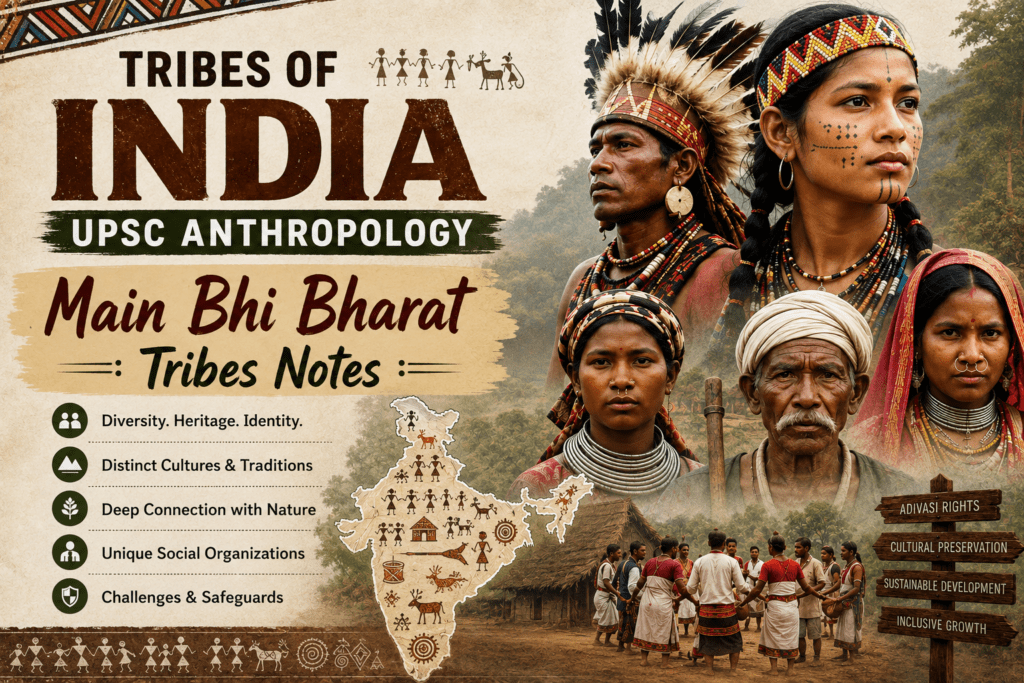
The tribes of India carry more marks in UPSC Anthropology than almost any other single area, because a named tribe can be used as evidence in Paper II tribal-development questions, in Paper I questions on kinship, religion and economic organisation, and in GS-I society answers. This page covers 26 Indian tribes — region, language, ethnographer, economy, kinship, political organisation, religion and contemporary problems.
Each entry opens with the ethnographer who studied the tribe and the monograph they produced — Rivers on the Toda, S. C. Roy on the Munda and Birhor, Fürer-Haimendorf on the Apatani and Konyak, Elwin on the Bonda — because naming the fieldworker and the work is what separates an Anthropology answer from a general-studies one.
Key takeaways
- 26 tribes across the Northeast, Central and Eastern India, Western and Northern India, South India and the Andaman and Nicobar Islands.
- Nine are Particularly Vulnerable Tribal Groups: Bonda, Birhor, Lodha, Great Andamanese, Sahariya, Gadaba, Parang Proja, Khond and Onge.
- The Bhil are the largest Scheduled Tribe in India by Census 2011; the Bodo are the single largest tribal community in Assam.
- State interventions worth quoting: Bonda Development Agency (1977), Lodha Development Agency (1986), FRA 2006, the Samatha judgement (1997) and the third Bodo Accord (2020).
All 26 tribes at a glance
Tap a name to jump to the full entry.
| Tribe | Region | Signature element |
|---|---|---|
| Apatani | Arunachal Pradesh | Zero-tillage rice–fish system; the Buyan council |
| Ao Naga | Nagaland | The Dobhashi customary law court |
| Angami Naga | Nagaland | Khonoma, Asia’s first green village |
| Bonda | Odisha | The Sindibor stone circle; bride older than groom |
| Bodo | Assam | Dong irrigation; the Bodo Accord of 2020 |
| Betta Kurumba | Nilgiris, Wayanad, Mysore | The east-facing Ambali platform |
| Birhor | Jharkhand | Sing Bonga; literacy at 1.6 per cent |
| Bhil | Rajasthan, Gujarat, MP | Largest ST in India; the gameti headman |
| Bhattra | Chhattisgarh | Ant chutney; the red-ant cure for malaria |
| Tharu | Bihar and the Terai | Thalassemia-linked malaria resistance |
| Toda | Nilgiris, Tamil Nadu | Fraternal polyandry; dairy-temples |
| Rabha | Assam | Baikho festival; a language near extinction |
| Lodha | Odisha and West Bengal | Ex-criminal tribe, denotified in the 1960s |
| Great Andamanese | Strait Island, Andamans | Population fell from thousands to 19 |
| Sahariya | Madhya Pradesh | Patore stone roofs; TB at 1,995 per lakh |
| Gadaba | Odisha and Andhra Pradesh | Dhemsa dance; the Girijana Garjana protest |
| Konyak Naga | Nagaland | The Angh at Longwa; the Morung |
| Munda | Jharkhand | Sarna dharam and Singbonga; Birsa Munda |
| Halbi | Chhattisgarh | The Dhankul, played only by women |
| Koya | Odisha and Andhra Pradesh | Three named forms of marriage |
| Nyishi | Arunachal Pradesh | Nyokum; the Bhooda log in red coats |
| Parang Proja | Andhra Pradesh | Animal-totem clans; the weekly market |
| Khond / Kondh | Odisha | The Meriah human sacrifice |
| Onge | Little Andaman | Dongi boats; the welfare-dependency debate |
| Nicobarese | Car Nicobar | Odi boat races; the Tribal Parishad |
| Tagin | Arunachal Pradesh | Gao Boodha elders; egg divination |
The 26 tribes in detail
01. Apatani — Arunachal Pradesh
Most developed NE tribe
Region, language & ethnographer. Ziro valley, Lower Subansiri, Arunachal Pradesh — both a valley and a plateau ringed by hills and forest. Language: Apatani / Tani, plus English and Hindi. Standard ethnography: C. von Fürer-Haimendorf, The Apa Tanis and Their Neighbours (1962).
Economy & food. Settled agriculture since ancient times; jhum deliberately not preferred — valley fertile and geographically safer. Zero-tillage; wet-rice + fish aquaculture on the same land — 2 rice crops + 1 fish crop. On UNESCO’s tentative list. No farm animals or machinery, yet very high productivity. Rain-fed perennial streamlets from the forest → they conserve the forest. Historically traded with Tibet for swords, held as prized possessions.
Family, marriage & clan. Gender-based role segregation still followed.
Polity & customary law. 7 villages in Ziro. Village council Buyan — supervises individuals and works by addressing conscience, not instilling fear. Land strictly segregated and designated: residence, grazing, cultivation, sacred groves. Elevated bamboo huts; a separate food buffer hut kept for emergencies.
Religion & culture. Nature worship — Sun and Moon. Sacred grove of blue pine and bamboo; revere forests, which prevented exploitation of forest resources. Women traditionally wore two coin-sized nose plugs and face tattoos — no longer followed. Festivals: Dree (prayer for a bumper harvest) and Myoko (celebration of friendship).
Issues & state intervention. Took up modernisation early. Literacy 86%. University and arts college in Ziro valley.
Source records no issues — use Apatani as the counter-case in any “tribal development has failed” argument.
Exam hook. Rice–fish + zero tillage; Buyan governs by conscience, not fear.
02. Ao Naga — Nagaland
Region, language & ethnographer. Mokokchung district — one of the largest Naga tribes. Language: Ao (and Ahom); because they speak two languages they are known as Dobhashis. Studied by J. P. Mills, The Ao Nagas (1926).
Economy & food. Modern economy with all kinds of jobs; good education system, good literacy, English learnt. Origin stories: born in a cave called Lungtrok; came from 6 stones south of the Dikhu river, Sangtham region — each stone one clan; crossed the Dikhu, hence “Ao” = having left. Historians link them to peoples of Myanmar further east.
Family, marriage & clan. Mostly joint family. Marriage: clan and village exogamy. If a man cheats on and abandons his wife, the wife’s side can quote any price as a fine and the man is obligated to pay it.
Polity & customary law. Clans based on nature. Formerly a village headman, Ao La, monarch-like with final decisions — not a heritable position but held for ~30 years. Now the village council decides by consensus, members nominated, not elected; the Ao La now only informs people of proceedings after meetings. Unwritten customary law; appeal lies to the Customary Law Court, locally “Dobhashi” — colonists chose bilinguals for these posts. Murder, rape, land boundary and water disputes settled case by case, verbally. Customary law requires every house to keep bamboo shoots filled with water outside — fire risk in thatch, bamboo and wood homes.
Religion & culture. Previously animism; Christian missionaries from 1877; now almost all Christian, with a Baptist church at the centre of the village. Village kept very clean; traffic rules followed properly.
Issues & state intervention. Women hold a better status than women elsewhere in India, but the tribe is not egalitarian — women cannot be members of the Customary Law Court, the reason given being that women marry out of the village. The village council pooled MGNREGA money to build an ashram for people over 70, who live there making handcrafted products sold for its maintenance.
Exam hook. Dobhashi customary court; MGNREGA-funded elders’ ashram; nominated-not-elected council.
03. Angami Naga — Nagaland
Region, language & ethnographer. Mainly Kohima city, Nagaland; also Manipur. “Kohima” was the name given to the region by the British. Language: Ngami/Angami, Sal language family. Standard ethnography: J. H. Hutton, The Angami Nagas (1921). Verrier Elwin (1900s), who wrote that the Nagas made all the goods they used — clothing, jewellery, furniture.
Economy & food. Hill tribe practising terraced wet-rice cultivation, very labour intensive — hence land is a prized possession. Collect produce from surrounding forests. Food: all meats — cows, pigs, birds, frogs, insects; bee larvae a delicacy; fish and eel. They do not hunt wild animals for consumption — animals are domesticated for eating. Khonoma gave up hunting decades ago to save flora and fauna, earning it “Asia’s First Green Village”.
Family, marriage & clan. Society organised through village sub-divisions rather than a stated marriage rule in the source.
Polity & customary law. Formerly fierce warriors. Khonoma village has 3 sub-divisions called khels. A special institution they call a “nursery” teaches children their traditions, legends, great individuals and festivals. Historical backdrop: first to resist the British, 1830s; Khonoma burnt down twice; 1879 the region came under British occupation; in 1944 fought alongside the British against the Japanese — ~4000 British and Indian soldiers died, and the Kohima War Cemetery was built here.
Religion & culture. Heavily Christianised by missionary influx under British rule — around 98% Christian. Sekrenyi: a 10-day post-harvest festival with feasting, singing and dancing. Tati: a Naga folk song sung with a single-stringed instrument called Libuh, made from a dried carved-out bottle gourd covered with an animal bladder and a string tied to it. Bead necklaces extensively used by Angami women.
Issues & state intervention. Quite modernised through continued association with the British. The sense of sovereignty from never submitting to a foreign power still lingers and fed the Naga independence struggles.
Exam hook. Khonoma green village; Sekrenyi; terraced wet-rice → land as sovereignty.
04. Bonda — Odisha
PVTG
Region, language & ethnographer. Malkangiri district, Odisha. Language: Remo (Austro-Asiatic, Munda branch). Classic account: Verrier Elwin, Bondo Highlander (1950).
Economy & food. Not detailed in the source beyond forest-hill subsistence. Cow sacrifice appears as a death ritual, so cattle are ritually, not commercially, held.
Family, marriage & clan. 9 endogamous castes within the tribe. Both men and women have freedom to choose their partners. Bride price is paid. Matriarchal dominance is visible, as the woman is usually much older than the male (groom). Cow sacrifice is a death ritual.
Polity & customary law. Two groups — Onthalis and Keelo. Every village has gender-segregated institutions that train young men and women in their traditions and rituals. Each village has a headman and a pujari (Seesa). Disputes and political discussion happen at the Sindibor — a stone circle around a big tree where all important occasions, festivities and sacrifices also take place.
Religion & culture. Worship of ancestors and other gods. Main god Patkhaanda — essentially a sword hidden in a banyan tree, brought out once every year with an animal sacrifice. Women wear large silver/aluminium neck rings, are semi-naked, and wear a waist cloth called Ringaa which they weave themselves; lots of beaded chains cover the torso; heads are shaven and a beaded head turban worn. Most today wear night gowns and other discarded modern clothing.
Issues & state intervention. Bonda Development Agency, 1977 — efforts improved population, literacy rate and sex ratio; a separate school for girls was built to encourage them to study. Issue: their FRA land rights are still not formally recognised.
Exam hook. Sindibor stone circle; Patkhaanda sword-god; older bride, younger groom.
05. Bodo — Assam
Largest ST in Assam
Region, language & ethnographer. Single largest tribal community in Assam, over 5–6% of the state’s population; controlled large parts of Assam in the past. Four districts — Kokrajhar, Baksa, Udalguri, Chirang — constituted the BTAD. Language: Boro, a Boro-Garo language of the Tibeto-Burman branch of Sino-Tibetan; one of the 22 scheduled languages; in 1974 Bodo became a separate language from Assamese with Devanagari script.
Economy & food. Mostly settled farmers, largely for domestic purposes. Traditional irrigation called the Dong system. Men mainly in the farm; women work the farm, run the home — food is their number one priority — and are part of handloom textile production, using cloth domestically and selling the surplus at weekly markets.
Family, marriage & clan. Marriage: the groom and the groom’s friend dress up exactly the same and sit next to each other, with the bride on the other side of the groom. No caste and no dowry system. Clan system based on livelihood and work.
Polity & customary law. Clans named by function — Swargiary the priestly clan (Deoris and Ojhas are selected from it), Basumatary the land-holding clan, Owary associated with the supply of bamboo. Colonisation was a reason for much of their development.
Religion & culture. Worship many gods, follow Hindu tradition, nature worship seen; sacrifices performed to please gods. Houses of bamboo and mud; they believe in feng shui / vaastu, so cleanliness, the position of the door and the puja room are considered while building a home. Different dances for different festivals; Bagrumba is the famous Bodo dance.
Issues & state intervention. Low literacy, high dropout; only 19 hospitals for 1068 villages. 2003 MoU between Centre, State and tribal leaders created the Bodoland Territorial Council — aims: economic, academic and linguistic development; land rights; cultural and artistic protection; infrastructure. BTC report: irrigated land fell by about half from 2011-12 to 2012-13; MGNREGA payments delayed; funding not as per agreement. Settled by the third Bodo Accord, January 2020 — signed with all NDFB factions and ABSU; ~1550 cadres surrendered, the NDFB dissolved, BTAD was reconstituted as the Bodoland Territorial Region (BTR), and Bodo became an associate official language of Assam.
Exam hook. Dong irrigation; Swargiary–Basumatary–Owary; “Divide Assam fifty-fifty” (ABSU, Upendra Nath Brahma, 1987); PTCA 1966-67; BdSF 1986 (Ranjan Daimary) → NDFB; fallout of the Assam Movement 1979-85.
06. Betta Kurumba — Nilgiris, Wayanad, Mysore
Region, language & ethnographer. Nilgiris (TN), Mysore (Karnataka), Wayanad (Kerala). Language: Betta Kurumba, a Dravidian language similar to Tamil. Recorded by Edgar Thurston, Castes and Tribes of Southern India (1909) and by Ayyappan.
Economy & food. Traditionally hunter-gatherers dependent on forests and wildlife, and artisans making bamboo baskets. After the 1940s, with forest decline and the coming of tea plantations, they started working in the tea estates for a livelihood. Food: sambar and rice staple; also meat.
Family, marriage & clan. Village system; formerly migratory, now settled. Women are treated on par with men.
Polity & customary law. Village headman Mukhya — his duty is to keep tribal traditions alive and resolve disputes among members. In the middle of the village is a shed on a raised platform called the Ambali, always built facing east — a sacred place where worship rituals and cultural and political gatherings take place.
Religion & culture. Nature worship; spirits are the gods. Celebrate the Malayali new year Vishu and the Kannada new year Ugadi; Shivaratri also celebrated. In the new-year festivals women sing and dance in a circle in the morning, singing about their daily life and the Sembu tree. At night the actual festival begins — each village has a head pujari; two fires are lit in the Ambali and the pujari invokes spirits, then walks around the Ambali talking to people and blessing them, followed by feasting, dancing and singing.
Issues & state intervention. Electricity, water and medical facilities now available. Modernised — modern clothes, steel utensils instead of bamboo, mainstream Hindu festivals, some have mobile phones, and they have access to education.
Exam hook. Ambali east-facing platform; Mukhya; Thurston.
07. Birhor — Jharkhand
PVTG
Region, language & ethnographer. Considered one of the earliest tribes of India. Population estimated 8,000–10,000. Jharkhand in high number, plus Chhattisgarh, Odisha and West Bengal. Language: Birhori, of the Austro-Asiatic family; they also call it Parsi or Parchi. Studied by Sarat Chandra Roy, The Birhors (1925).
Economy & food. Forest dwellers with a hunter-gatherer economy. Practise no form of agriculture of their own and are entirely dependent on the collection of forest products; they also do some agriculture, animal domestication, and work as labourers in nearby industries; slash-and-burn/shifting cultivation; domesticate cow, goat, hen. Excellent rope-makers from forest collections. Collect Chironji (char), Mahua, Tendu patta, Tendu phal, bamboo, firewood and leaves for huts. Some collect medicinal plants, leaves, fruits and bark and serve as the Baiga (medicine man) for villagers. Food: rice staple with sag, beans and mahua; fond of jungle meat — fowl, chicken, goat, monkey, pig.
Family, marriage & clan. Mostly nuclear, some joint. Monogamy preferred, but polygyny present — driven by Chhattisgarh govt schemes for below-poverty-line women and by the need for more hands under poor economic conditions.
Polity & customary law. Settlements called Tandas — groups of families. Homes of sticks and leaves with thatched roofs; govt resettlement has given pakka homes plus ration, education and health schemes.
Religion & culture. Revolves around ancestor worship and animism; parents worshipped as god and goddess; also Hindu tribal religion. They hold that the whole universe is created and presided over by Sing Bonga, the sun, and his wife Chandu Bonga.
Issues & state intervention. Literacy 1.60%. Land displacement as govt procured their land for development — but no development has happened; resettlement pending for more than 20 of 32 recorded villages. No autonomous government granted despite being part of the Fifth Schedule. Still fighting for land rights and local laws. Govt forest schemes are very strict and stopped them collecting forest produce — only 10% are now completely dependent on the forest.
Exam hook. Sing Bonga & Chandu Bonga; Tanda; 1.6% literacy — the floor case.
08. Bhil — Rajasthan, Gujarat, MP
Region, language & ethnographer. Population 16 million. Gujarat, Rajasthan, MP, Maharashtra, AP and Karnataka. The name “Bhil” derives from villu / billu, which in Dravidian means bow. Largest Scheduled Tribe in India (Census 2011); the Gonds are second. No single standard monograph — the largest tribal population in India is among the least ethnographically documented.
Economy & food. Farmers, with houses inside the farm at the centre. Due to water scarcity many are leaving their villages to find work elsewhere. Food: maize, onion, garlic and chilli, cultivated in their small farms.
Family, marriage & clan. Divided into a number of endogamous territorial divisions, which in turn contain a number of clans and lineages.
Polity & customary law. Traditional villages led by a headman, the gameti, who has authority and decision-making power over most local disputes or issues. They trace their ancestry to Ekalavya, the archer who could defeat Arjuna, and Valmiki, chronicler of the Ramayana, is said to have been a Bhil.
Religion & culture. Hinduism — they appease deities of the forest and evil spirits, besides puja of Shiva and Durga. A small percentage Christian. They cremate their dead, followed by a series of rites. Traditional dress: men wear pagri and gamccha; women wear sari and ghagra choli.
Issues & state intervention. Water scarcity the major issue — farming a stretch when there is no water even for drinking. Water-led migration → high dropout rates despite a high number of schemes. Malnutrition dominant. No effective tribal leadership. History: rebelled repeatedly in the colonial era — 1846, 1857-58, 1868; landlords, afraid of Bhil numbers, brought in colonial military force, once killing about 1500 people. Mainstream history does not carry this; living witnesses remain.
Exam hook. villu = bow; gameti; Ekalavya and Valmiki claim; leaderless despite the largest numbers.
09. Bhattra — Chhattisgarh
Region, language & ethnographer. Chhattisgarh and Odisha mainly — about 2 lakh and 1 lakh respectively; some numbers in MP and Maharashtra. Ant chutney is a delicacy in Baniya village, Bastar region, Jagdalpur district.
Economy & food. Food gathering plus pre-modern cultivation (lack of modern technical knowledge of methods). Depend on the forest for firewood. Man hunts, woman gathers: women collect water from nearby wells and natural springs; men hunt birds and bird eggs. Young mynahs sometimes reared as pets. Wild ants (cheenti) are a delicacy — ant chutney. Money still very limited, so only small parts of the village are used for farming.
Family, marriage & clan. Not detailed in the source.
Polity & customary law. Not detailed in the source. Their bargaining problem is with the state, not internal: they need protection from things that hinder their progress in availing govt schemes.
Religion & culture. Puja and prayers to their deities are a community event — night-long kirtans, with sanatan-dharm-regulated puja during the day, celebrated with food and drink after puja. A male singer sings folk songs, mostly attended by women. Tribal cures: for malaria, the patient sits under the tree where wild red ants are found and the ants are showered on him — their bites are said to cure him. For headache, Nilgiri leaf is placed on the forehead and around the head.
Issues & state intervention. The tribe is undergoing change and integrating with the modern — anganwadis and schools nearby offer work, and modern farms offer them work. They need protection from what hinders their access to govt development schemes.
Exam hook. Ant chutney; red-ant malaria cure; the cleanest illustration of the sexual division of labour.
10. Tharu — Bihar and the Terai
Region, language & ethnographer. Indigenous to the Terai — southern Nepal and northern India; South Champaran, Bihar sees major numbers; also Uttarakhand and UP. Language: dialects of Tharu, of the Indo-Aryan subgroup of Indo-Iranian; also Hindi, Urdu, Awadhi, Maithili. Origin — three competing claims: Rana Tharus claim Rajput origin, migrating from the Thar Desert; eastern Tharus claim descent from the Śākya and Koliya of Kapilvastu; anthropologists in 1941 said the tribe is of Mongoloid origin and entered Nepal and India.
Economy & food. Based on agriculture and forest. Mostly farmers who follow shifting cultivation (85%); harvest sugarcane, paddy and wheat; fishing and pastoralism also seen. Women make baskets in their free time, used at marriages by the bride’s parents to place gifts for the bride as she enters her new home.
Family, marriage & clan. Patrilocal and patrilineal; both joint and single-family systems found. Critically: the family, not the individual, is punished in case of a breach of tribal custom or law.
Polity & customary law. Many clans, called Kuri in their language. There is a Gumastha — a traditional elected leader — and no work is done without his approval or word.
Religion & culture. The word “Tharu” is believed to derive from “sthavir”, meaning followers of Theravada Buddhism. Hinduism, Buddhism and traditional beliefs; Durga Puja, bhajans, and dances such as Jhamta and Jhoomar. They follow Hindu religion but are purely a tribal community from an anthropological point of view. Homes of bamboo and sand; cleanliness of utmost priority; famous for sports ability — govt-sanctioned football and sports academies exist but are inadequate; women skilled at handloom. Genetics — the highest-value fact here: Tharus survive in the malarial parts of the Terai that were deadly to outsiders. Contemporary medical research found malaria incidence nearly seven times lower among Tharu than neighbouring ethnic groups; researchers concluded the difference pointed to genetic rather than behavioural or dietary factors, confirmed by follow-up finding genes for thalassemia in nearly all Tharu studied.
Issues & state intervention. The state has not applied FRA 2006, partly because of Tiger Reserve designation. Roads very hard to traverse; some villages reachable only on foot. The Digital Bharat plan causes problems as they have no mobile networks nearby; only about 50% have Aadhaar cards; ration, pension and panchayat funding not reaching them. UP has a Homestay scheme — the Forest Department offers tourists a stay in the Tharu natural habitat on the international border with Nepal in huts made of forest grass; the Department trains the tribals to communicate with tourists and to attend to cleanliness and safety; the tribals charge for home-cooked meals and accommodation.
Exam hook. Thalassemia and malaria resistance; Gumastha; family punished, not the individual; FRA blocked by a Tiger Reserve.
11. Toda — Nilgiris, Tamil Nadu
Region, language & ethnographer. Nilgiris — where Irulas, Badagas and Kurumbas also live; the Todas are the best known and are the pastoralists. Only 1500 survive today, spread over 600 small villages. Physical anthropology: Egon Freiherr von Eickstedt (1934) described them as of the North Indid division of the Indid type, connecting them to the ancient Proto-Dravidian population. Classic ethnography: W. H. R. Rivers, The Todas (1906) — the work in which he set out the genealogical method. Frazer mentions Toda lifestyle in The Golden Bough.
Economy & food. Pastoralists and herders of the Nilgiris, especially of buffaloes. Traditionally vegetarian — rice, chutney and vegetables. Tribal exchange: different tribal systems were linked to one another by a hereditary system; economic exchange had ritualistic and social significance as opposed to random exchange in a marketplace, and tribes performed different rituals and ceremonial acts for one another.
Family, marriage & clan. Fraternal polyandry. Marriage is initiated in childhood and completed at maturity, and is flexible and can be changed. A child is recognised as a social being at 1–3 months, when it is given a name and marriage is initiated.
Polity & customary law. A village consists of only 3–4 houses with compact huts. The temple hut is set apart from the houses, uniquely designed, made of bamboo and hardwood and thatched with grass, with wooden planks as boundary walls. Earlier homes were built this way too; now, due to a shortage of grass, only temples are.
Religion & culture. Hindu god worship in large number; the generic name is tovit, meaning gods of the mountains; Teikirshy (goddess) and Ondt (god), a sibling duo, are the most famous. Buffaloes are of two kinds — sacred and ordinary; the sacred are tended only by priests and dairymen. Conical temples are actually dairies, considered sacred; these divine spaces are not accessible to women; churning of milk, buttermilk and butter takes place there once a year. Until about 20 years ago tattooing was mandatory for women after puberty; now a small tattoo is prevalent. Death is the longest and most elaborate ritual — both patriclan and matriclan members are present, Irulas play the tunes as Todas are not allowed to play music, and buffaloes are sacrificed. They stand out by their white cloaks with embroidered colourful patterns worn over sarees or shirts — which led some anthropologists to speculate the Todas came from ancient Sumer.
Issues & state intervention. Five state interventions, four of which failed: (1) new concrete houses in the traditional shape — unsuccessful, too cold; (2) land rights to switch to farming — negative effect: not used to agriculture, so land was leased to other farmers and the money used for liquor — alcoholism is a huge problem; (3) the new plantation policy putting pine and eucalyptus in place of traditional shola forest and pastures, causing damage and pollution; (4) high milk-yielding buffalo varieties needing stall feeding — unsuitable for the Toda lifestyle; (5) the one success — embroidery groups for women and milk cooperatives, with the Registrar of Geographical Indications granting GI status to Toda embroidery. Bottom line: pastoralism as a way of life is in decline.
Exam hook. Fraternal polyandry; dairy-temples closed to women; GI embroidery as the lone success.
12. Rabha — Assam
Region, language & ethnographer. Primarily Assam, also West Bengal and Meghalaya; spread unevenly across 23 districts; the study is in Baksa district. Language: Rabha, a Sino-Tibetan language with two dialects, Maituri and Rongdani — but very few speak it and the language is on the verge of extinction; most speak only Assamese, few know Hindi.
Economy & food. More than 70% dependent on agriculture. Women are expert weavers but weave only for their families — no access to markets or marketing knowledge, which implies no income obtained from weaving. Sericulture carried out, but it takes a long time and needs 2000 silk worms for good returns. MGNREGA is there but no work is allotted and job cards are not even received. Small-scale fishing. Food: crabs, fish and rice beer on special occasions; even silk worms are fried and eaten.
Family, marriage & clan. Pre-marriage rituals do not involve the groom; women play an important role in festivities.
Polity & customary law. Because Rabhas are widely spread out across Assam it has become very difficult to unanimously demand facilities or finance from the government. They are not cared for by the government because they do not contribute much to vote-bank politics. Baksa comes under Bodoland Council administration, which shows no interest in bringing up the Rabhas — hence they are demanding a Rabha Autonomous Council.
Religion & culture. Animism with a lot of Hindu influence. Culturally very rich — more than 10 dance forms and a lot of folk songs; women and men dance in circles to the tune of flute and cymbals. Most festivals are related to agriculture; the main festival is Baikho, before the spring harvest. Great individual: Bishnu Prasad Rabha, renowned poet, painter and songwriter, fondly known all over Assam as Kalaguru; even Bhupen Hazarika used to sing his songs.
Issues & state intervention. Very backward economically, very low literacy, almost no awareness of the schemes available. A primary school was built but midday meal funds were not received for an entire year. Dropout very high, less than 5% reach graduation level. Live in bamboo and clay houses.
Exam hook. Baikho; Kalaguru; language extinction; the vote-bank explanation for neglect.
13. Lodha — Odisha and West Bengal
PVTGDenotified
Region, language & ethnographer. Odisha and West Bengal; the study is in Mayurbhanj, Odisha. Language: Kudumali and Odia. Studied by P. K. Bhowmick, The Lodhas of West Bengal (1963) and P. C. Ray. The British declared the Lodhas a criminal tribe; they were denotified in the 1960s and efforts were made to develop them.
Economy & food. Traditionally foragers and hunters, using bow and arrow, foraging the jungles around. Primarily known earlier for collection and breeding of tussar silk cocoons — no longer possible due to decreasing forest cover. Only now beginning to learn cultivation; only a few families got the FRA land patta, many still have none. Sabai grass ropes made and sold. Now depend on collecting medicinal herbs and roots — walking 20–40 km to reach the forest and another 20 km to reach the market, where they must accept whatever price the buyer offers. MGNREGA has not provided a single day of work for them.
Family, marriage & clan. Not detailed in the source.
Polity & customary law. Not detailed in the source. Effective governance for them runs through the failed development agency rather than a customary body.
Religion & culture. Many magico-religious beliefs. Believe in good and evil spirits. Have a firm belief in witches and their evil power. Some Lodhas have converted to Islam.
Issues & state intervention. Got pakka houses under the Indira Awas Yojana; electricity and water there but no food; residential schools built; the Lodha Development Agency was built in 1986 for all-round development — and the Agency failed miserably. Malnourishment in children visible; literacy 34%; teachers in the residential school teach in Santhali, so Lodha children who cannot understand are sent back home; women and children do not even have enough clothes; not a single family is above the poverty line.
Exam hook. Criminal tribe → denotified; tussar cocoons lost with forest cover; Santhali-medium school failure.
14. Great Andamanese — Strait Island, Andamans
PVTG
Region, language & ethnographer. Originally lived in Port Blair; in 1968 the Indian govt, in an effort to resettle them, shifted them to Strait Island. Language: Bo and Jeru, but almost nobody knows it now — most speak Hindi. Racial stock: Negrito; believed to have lived in the Andamans for more than 70,000 years. Population 59 in 2020. Classic ethnography: A. R. Radcliffe-Brown, The Andaman Islanders (1922) — the study behind his structural-functional treatment of ritual. Currently working there: Vishvajit Pandya.
Economy & food. Used to hunt wild animals, mostly boars; also eat turtles, fish and fruits. A nomadic tribe that used to settle around water bodies in large groups. Experts at making boats from a single log of wood by hollowing out the middle of the trunk. Still occasionally hunt and even cultivate certain crops.
Family, marriage & clan. Many Great Andamanese women marry non-tribal outsiders because all the men left in their tribe are brothers — the sharpest demographic consequence of collapse in the whole set.
Polity & customary law. They have a head-chief. For a long time they were hostile and even attacked any outsiders; the situation has changed now.
Religion & culture. Previously lived in isolation, probably even cannibalistic, and did not wear clothes. Contact came in the 1800s when the British were building the Cellular Jail at Port Blair; the tribe attacked the British. Due to this contact and gradual acculturation they lost many of their original culture traits.
Issues & state intervention. Population was in the 1000s; with British attacks and the introduction of alcohol and the spread of epidemics in a highly isolated, low-immunity tribe, numbers fell to as low as 19. Today the govt provides free ration and has built a primary school; most children are sent to a residential school in Port Blair; all of them speak Hindi and even watch Bollywood movies.
Exam hook. 1000s → 19 → 59; Strait Island 1968; Bo and Jeru; contact-and-collapse model.
15. Sahariya — Madhya Pradesh
PVTG
Region, language & ethnographer. Ethnic group of Madhya Pradesh — Shivpuri, Vidisha etc. — and a few regions of Rajasthan. Since they may be surrounded by speakers of other languages and dialects they may speak various Hindi dialects.
Economy & food. Farming 28% of the population, some settled cultivators; 57% are farm-hands / agricultural labourers (2001 census); traditionally rearers of goats. Wheat, pearl millet and maize the main cereals; gram and arhar the main pulses. Agriculture largely rain-dependent, with merely 2% of total land area irrigated — mainly seasonal wells and rivulets. 70% are labourers or landless labourers, earlier bonded labourers. Forest: expert woodsmen and forest-product gatherers, particularly skilled in making catechu from Khair trees; the main business is gathering and selling forest wood, gum, tendu leaf, honey, mahua and medicinal herbs; also baskets, mining, quarrying and breaking stones; hunt and fish. They collect for home alone as the market is far; jadi booty fetches Rs. 100 per kilo.
Family, marriage & clan. Small joint families. The elder sons live separately after marriage and the youngest son bears the responsibility of the parents and unmarried brothers and sisters.
Polity & customary law. Every adult member is part of a governing council headed by a patel. The patel’s appointment is hereditary, but being found unfit or unsuitable is a basis for removal. The council decides disputes by consensus and imposes fines and ostracism on offenders guilty of rape, elopement or adultery. An inter-village dispute is referred to a Chokla Panchayat.
Religion & culture. Animism, with folk Hinduism also followed. Houses of prehistoric standards made of stone boulders with roofing of stone slabs locally called patore; some mud structures; brick and concrete very rare.
Issues & state intervention. Literacy 28%, of which 15% can only write their name; 62% drop out of primary school; 2% clear high school. Land: the patta is in the adivasis’ names but land and resources have been generously usurped by other caste groups, and even when in possession many pawn it to supplement meagre income. No pakka roads. Acute malnutrition from crushing poverty, delayed breastfeeding, premature pregnancies and seasonal migration — every second child under five in Shivpuri and Sheopur is underweight; 20% of kids died in 6 months as of 2016; day-care centres set up but one ran only 2 months, and they cover a child’s needs for only 14–21 days. ICMR: TB prevalence 1,995 per 1,00,000. MGNREGA and Antyodaya benefits not fully available; everyone has an MGNREGA card but no work for even a single day; women get work only 3 days a month. FRA 2006 land rights not recognised. Money lending, indebtedness and bonded labour still present; implementation inadequate due to corruption. Verdict: understand the tribe and their needs instead of imposing mainstream general schemes.
Exam hook. Patore stone roofs; Chokla Panchayat; TB 1,995/lakh — the strongest health-deprivation statistic in the set.
16. Gadaba — Odisha and Andhra Pradesh
PVTG
Region, language & ethnographer. Found in AP, Odisha, Chhattisgarh and Jharkhand. In AP and Odisha they speak Dravidian languages similar to Telugu (Konekar Gadaba) and Odia (Ollari Gadaba); in Chhattisgarh and Jharkhand they are called Gutob Gadabas and speak Mundari, of the Austro-Asiatic family. A single tribe split across two language families — a ready example for linguistic classification questions.
Economy & food. Practise shifting / podu cultivation in Araku valley; of late they have taken up ploughing also. Ragi is their staple food; forest produce like fruits also consumed. Currently an unemployment problem, but MGNREGA helped them.
Family, marriage & clan. Patrilineal society. Several clans — Gutob Gadaba, Bodo Gadaba, Parangi Gadaba — and clans are endogamous.
Polity & customary law. They live in permanent villages.
Religion & culture. Women wear 0.5 kg heavy neck rings that are only removed after their death. Women and men are now also found wearing modern clothes. Dhemsa is their famous tribal dance.
Issues & state intervention. Govt provides subsidised ration and food; PVTG status granted; children can be educated in tribal residential schools, but parents are not willing to send their girl child. MGNREGA has been of great help but they still do not get the promised minimum wages even after linking Aadhaar. Under FRA 2006 PVTGs have a right to cultivate forest land, but they have not received their pattas. No drinking water. Great problem of mining and hydro-electric projects — the Araku Gadaba region is a Schedule 5 area where, under the Samatha judgement, no private company may mine; but the governments also want to mine. Araku valley is rich in bauxite; since 1980 there have been efforts to displace the tribals and mine the area, which the Gadabas have stalled by protest — “Girijana Garjana” was one such massive protest. They do not trust the government one bit.
Exam hook. Dhemsa; 0.5 kg neck rings; Girijana Garjana; Samatha 1997 + Schedule 5 + bauxite.
17. Konyak Naga — Nagaland
Headhunters
Region, language & ethnographer. Mon district, Nagaland, and Myanmar. The Konyaks speak as many as 20 languages, varying across villages, and no language has a script. Studied by C. von Fürer-Haimendorf, The Naked Nagas (1939) and The Konyak Nagas (1969), and by Verrier Elwin — Elwin was tribal advisor to the North East Frontier Agency until 1964 under Nehru’s government.
Economy & food. Previously hunters and fierce soldiers constantly at war with other tribes. Now they have taken up jhum kheti — shifting cultivation, cultivating along the slopes of the hill, with bamboo bunds built to prevent soil erosion. Women weave their own clothes and make elaborate beaded necklaces and headbands. Each plot of cultivable land has a shed for resting as farmlands are far from their houses.
Family, marriage & clan. The Angh can have as many wives as he wants, but only the first wife is Queen, and her son becomes the next Angh. They live in bamboo longhouses.
Polity & customary law. All Konyaks have a king called the Angh — a hereditary position. The Angh appoints a chief in every village to the village council. Myanmar has 40 Konyak villages and India just 4; Longwa, shared between India and Myanmar, is home to the Angh’s palace. The Morung is an educational institution only for boys, where they are taught to hunt and trained in warfare, and is both an administrative and a judicial body. Village councils still use their customary laws for dispensing justice. Women are respected but not allowed to take part in political discussions. Land is very important — they would wage a war if anyone threatens to take away their land.
Religion & culture. Headhunters: bringing home the head of an enemy was a matter of pride and prestige. All the young men who brought back a human head were given a face tattoo as a rite of passage from boyhood to manhood; the more tattoos, the more accomplished and courageous. They believe human heads have a “soul matter” or “life force” which keeps evil spirits away when hung on their doors. Animal sacrifices on every festive and cultural occasion, with animal skulls decorating the walls of their houses; the village headman must contribute more animals than a common family. Log drums beaten on ceremonial occasions. It is women who specialise in the art of tattooing — the knowledge is passed on in only one or two particular families and not revealed to other families of the village.
Issues & state intervention. Christian missionaries who came in the 1800s were successful in getting the Konyaks to stop head hunting; the British banned the practice in 1935, and after 1970 there have not been any such incidents. Around 98% converted to Christianity. The British introduced opium smoking to the Konyaks and quite a lot of them have become opium addicts.
Exam hook. Angh at Longwa; Morung; face tattoo as rite of passage; banned 1935; opium as a colonial legacy.
18. Munda — Jharkhand
Region, language & ethnographer. Mainly Jharkhand, Odisha and West Bengal, with lesser numbers in Chhattisgarh, Bihar and MP. An ancient tribe of India. Birsa Munda — tribal freedom fighter. Language: Mundari — Austro-Asiatic, Munda branch, a stock distinct from Indo-Aryan. Studied by Sarat Chandra Roy, The Mundas and Their Country (1912).
Economy & food. Though agriculturists, they are mainly dependent on forests for livelihood. They collect forest produce and sell it in markets; the price of the collection is decided by the Gram Sabha of the village, but the actual sale price depends on the market price, which is comparatively very low. They also domesticate animals. Highly dependent on money lenders as market prices for their products are extremely low. Everyone in the community eats together during festivals; Handia / Hadiya, a rice beer, is taken on special occasions. They collect Chironji, Mahua and Lac, major parts of their livelihood.
Family, marriage & clan. Clans among Mundas are known as Killi, similar to the Sanskrit Kula. Patrilineal — the clan name descends from father to son, and by tradition people of the same clan descend from the same forefather. Clans are of totemic origin, named after important household items, animals or birds. Rituals for birth, death, engagement and marriage: the birth of a boy is celebrated as an earner and the birth of a girl as a family caretaker. Lota-pani is the engagement ceremony; Dali Takka, a monetary gift to paternal guardians, is generally paid before the marriage. Marriage is a week-long festivity.
Polity & customary law. They have their own gram sabha which meets regularly to conduct discussions on various issues, and decisions are collectively made. They are still fighting for complete authority over the forest.
Religion & culture. Munda religion is Sarna dharam, distinct from Christianity, Hinduism or Islam. The supreme deity is Singbonga, meaning the Sun god, who according to them saves them from troubles.
Issues & state intervention. FRA 2006 recognised tribal authority over forests and granted permission to collect tendu leaves, kendu fruits, herbs for medicine (jadi booty) and lac; forests may be used for grazing and water. In 2010 a cooperative was set up to decide fair pricing of forest produce, and the Tribal Rights Committee gave a report in 2011; many forest tribal products are now on the MSP list. But no industry has been formed for tribal products alone. Living in reserve forests they need protection, as many are victims of Naxal attacks. Medicine men, widely trusted over allopathy, need legal sanction and recognition. Birsa Munda’s name is used on a lot of infrastructure, but even the road to his village is kaccha. Deforestation is hurting their livelihood.
Exam hook. Sarna dharam / Singbonga; Killi totemic clans; Lota-pani and Dali Takka; gram sabha price vs market price.
19. Halbi — Chhattisgarh
Region, language & ethnographer. Chhattisgarh, Maharashtra, MP, Odisha and parts of Gujarat. Anthropologist who studied them: no prominent anthropologist — the tribals themselves were motivated to modernise. That absence is itself the point: development here was endogenous, not researched or administered into being.
Economy & food. Cultivators traditionally and even now. The bull is mainly used to plough the field, but tractors are now used by many, and even hybrid seeds and pesticides are used to improve agricultural productivity.
Family, marriage & clan. Halbis have several distinct gotras, and marriage within the gotra is not permitted — clean gotra exogamy.
Polity & customary law. They live in a proper village. No defined political structure.
Religion & culture. Originally nature worshippers; they worship ‘Sheetali mata’, who is installed as a wooden swing in a temple. Over time many Hindu gods were incorporated too, and Hindu festivals are celebrated. Teej is celebrated by them mainly. A special musical instrument called the Dhankul is played — made from a pot, rice grains, a bow and a cane window; only women play it and sing. Both men and women fast for the family’s prosperity.
Issues & state intervention. The community participated aggressively in economic development and obtained Scheduled Tribe status. Use Halbi as the counter-example to state-led development everywhere else in this list.
Exam hook. Dhankul, played only by women; Sheetali mata as a wooden swing; self-driven ST recognition.
20. Koya — Odisha and Andhra Pradesh
Region, language & ethnographer. Found in Odisha, AP, Telangana and Chhattisgarh; the study is in Malkangiri, Odisha. Language: Gondi (Dravidian), with two dialects — North and South Koyas. The North Koyas’ language has Odia words mixed in and they are relatively more primitive; the South Koyas have Telugu words. Anthropologist: Edgar Thurston, 1909, according to whom the Koyas were formerly armed soldiers in the service of palegars and used to practise podu cultivation.
Economy & food. Pigs and cows are considered assets. Initially practised shifting cultivation, now switched to settled cultivation and crafts — expertise in bamboo furniture and basket making. Of late the males go out as migrant construction labour to towns and cities, their families staying behind in the village. They still follow the barter system due to lack of money; pigs and cows are traded; a haat is organised from time to time.
Family, marriage & clan. Five exogamous gotras / clans in a village. Three types of marriage: (1) Pendul — traditional marriage, cross-cousin marriage permitted; (2) Karsu Pendul — the bride is captured by the groom, or they elope; (3) Lon udi vata — the bride goes to the groom’s house and refuses to leave. In all three the groom’s family has to pay bride price in pigs / cows.
Polity & customary law. They live in temporary villages: in case of lack of food or a disease outbreak they desert their current village and settle somewhere else.
Religion & culture. Cock-fights are popular. Koyas believe that diseases are caused by evil spirits, and still go to tantrics for healing illness. They erect 1 m menhirs to commemorate their dead elders.
Issues & state intervention. No medical facilities available even today. In 2016 there was an outbreak of Japanese encephalitis — around 200 children died; it spread from the pigs through mosquitoes; no immediate medical aid was provided. Later a team of doctors came and ordered all pigs to be slaughtered — but pigs were an important source of food and an asset to the Koyas. Due to the economic losses they had to work as migrant labour in other states, so MGNREGA would be very useful here. FRA 2006 provided them with cultivable land and some Koyas built pakka houses. During the 1970s an influx of refugees from Bangladesh and Myanmar was settled in Malkangiri by the govt, and there was hence a diffusion of culture traits among the Koyas. The Polavaram project in AP is bound to displace many Koyas.
Exam hook. Three marriage types (Pendul / Karsu Pendul / Lon udi vata); JE 2016 and the pig slaughter as a development-vs-culture case; Polavaram displacement.
21. Nyishi — Arunachal Pradesh
Largest tribe of Arunachal
Region, language & ethnographer. Arunachal Pradesh. State total population 14 lakh, tribal population 10 lakh, Nyishi 3.5 lakh. Isolated till recent times, then focused on education to develop fast.
Economy & food. Modern — doctors, engineers, educators, govt jobs. First female IAS from the Nyishi tribe: Indira Mallo. An Organisation of Nyishi Graduates, about 30 years old, now has almost all Nyishi members.
Family, marriage & clan. Nuclear modern family; individual choice in marriage exists; no dowry. But the previous practice of polygyny is still present — a higher number of wives means higher status, and a man can have more wives if he is able to look after them. There is no concept of divorce: if abandoned by her husband, the wife cannot leave him.
Polity & customary law. High political influence. Customary laws are practised with a local dispute-redressal mechanism called “Bhooda log”, literally old people — wise men and women wearing red coats who take up the redressal of social and other disputes for as long as people accept them. The police and the panchayat system remain for appeals. Issue: the customary laws are not codified as the state is not part of the Sixth Schedule; they have applied for inclusion in the 6th Schedule and to amend Article 371(H) to safeguard the tribes of the state.
Religion & culture. Animism, worship of nature; Mother Earth is the deity (nyu kum, dharthi). Nyokum is the biggest festival — a 4-day festival; Nyo means land, Kum means togetherness. Previously, after Nyokum there were 5 days of not touching land or entering forests; now, due to busy life, only those who go to the altar and offer sacrifices follow it, so the taboo is not followed by everyone. After 5 days the priest is told about resuming normal (profane) activities. Dances: Rikampada and other forms, offered by Nyishi women; the music talks about the “festival of life”. Source margin note: eco-feminism — moon is a male figure, sun is a female figure.
Issues & state intervention. Women’s Commission set up; women getting educated and no longer ignorant. Summary: they have accepted modern technology and ways of development, but administration is still based on their customary laws, which handle social cases, while other civil or criminal cases are taken up by the Panchayati Raj system.
Exam hook. Nyokum; Bhooda log in red coats; the sacred/profane hook for Chapter 5 Paper I; Sixth Schedule + Article 371(H) demand.
22. Parang Proja — Andhra Pradesh
PVTG
Region, language & ethnographer. Visakhapatnam (AP) and Odisha. These people entered Araku Valley from Odisha around 300 years ago in search of a better life. Language: Porja / Proja, influenced by Odia and Telugu.
Economy & food. Currently podu — slash and burn agriculture; still awaiting pattas from the govt for land use. Not all are dependent on agriculture; there is a slow trend towards it, but the techniques used are still pre-modern. Paddy is grown, apart from vegetables. They domesticate goats and hens for trade and also gather forest produce — so they are agriculturists, pastoralists and forest gatherers at once. Trade: many varieties of mangoes here, used to make the famous “aam papad”, though they are forced to accept low rates. All products are sold at the weekly markets of the nearby town — the only economic activity of the tribals, hence a very important spot. Produce is officially known as Non-Timber Forest Produce; associations such as the Girijan Cooperative Society purchase in bulk but not the whole produce. Barter is a major system of trade, though minimal use of money is also seen; money earned is used to buy clothes, jewellery or material needed right there — they never just collect money and take it home. Fully dependent on the weekly markets, as they live in distant isolated forests and hills and transport is available only at this time of the week.
Family, marriage & clan. Marriage: clan endogamy.
Polity & customary law. Clan based: each clan is named after animals of the forest — Kilo for lion, Kora for sun, Samaridi for bear, Onthala for snake, and other names for monkeys.
Religion & culture. They live in houses made of Khaprail (roof tiles) with kaccha walls. The doors are the most intriguing part of the house — made with the most interest, decorated and designed to look attractive with different paintings and carvings — and they contain no symbolic meaning. A useful caution against over-reading material culture.
Issues & state intervention. Electricity finally reached, but still no school, hospital or drinking water supply; the whole village uses water from wells or nearby streams. Tribes near cities are better off. Govt schemes for these facilities would have a huge impact, as tribals could live without the fear of death from malaria and illness from malnutrition. They do not get rations from the govt in time, nor wages for the labour they do. Social groups are working on awareness and anganwadis are being set up for 0–6 year olds. Yojanas and schemes are not reaching them. They live in a scheduled area, still with no authority set up for their care and development.
Exam hook. Kilo/Kora/Samaridi/Onthala totem clans; decorated doors with no meaning; Girijan Cooperative and the weekly market as the only economy.
23. Khond / Kondh — Odisha
PVTG
Region, language & ethnographer. In AP and Odisha; Odisha is the origin place; the current study is in Araku valley. Language: Kui, a Dravidian language similar to Telugu. Other names: Dongria Khond, Kutiya Khond, Desiya Khond. Standard modern study: Barbara M. Boal, The Konds: Human Sacrifice and Religious Change (1982).
Economy & food. Subsistence farming. Initially practised only podu — shifting cultivation; now shifted to ploughing. Staple food is millets. Very poor — they share their huts with livestock.
Family, marriage & clan. Patrilineal and nuclear family structure. Children over 8 years are sent to live in gender-segregated dormitories — the classic youth-dormitory institution. Gender roles: an egalitarian society; women usually take up child care, fetching water from distant streams and gathering fruits, while men cultivate.
Polity & customary law. Many clans and subclans; clans are exogamous; villages are named after their totems. Clan wars were quite common during the British era. Villages now have village councils and panchayats, and women can also participate.
Religion & culture. Primarily animism. Bura Pennu — the sun, the creator god of the Khonds; Tari Pennu — the earth, the mother goddess. Khonds offer sacrifices to please their gods; till the 1840s human sacrifices (Meriah) were quite common among them, and the British put an end to that. Over time the Hindu gods, mainly Kali and Durga, were accommodated; Christian missionaries spread Christianity and around 3% converted. They believe death is caused by evil spirits, sorcerors and witchcraft. Khond women wear 3 nose rings, plus many ear rings, hairpins, neck rings and toe rings; Khond men wear only a loin cloth, though of late they have started wearing the discarded clothes of urban dwellers.
Issues & state intervention. PVTG status granted. Araku is currently under ITDA supervision, but with no fruitful results. The village is gripped by malaria; no drinking water available; a primary school was built but teachers do not attend; the midday meal is not guaranteed every day; there is no anganwadi centre either; aluminium contamination in the water. The region was provided with one water tank. Araku valley is suited to coffee and black pepper cultivation and tribals earn a living by this — but changing food habits and cash crops overtaking food crops are causing a decline in life span.
Exam hook. Meriah human sacrifice ended by the British; Bura Pennu / Tari Pennu; youth dormitories; cash crops → falling life span.
24. Onge — Little Andaman
PVTG
Region, language & ethnographer. Little Andaman. Population 118 now, 672 in 1901. Studied in recent decades by Vishvajit Pandya; earliest survey 1905. The Onge, or the “Madhumitha”, are among the earliest inhabitants of the Andamans. In 1880 Dr. Flower of the Natural History Museum stated that they had not come into contact with the outside world until the 1880s.
Economy & food. Traditionally hunter-gatherers; a few were resettled in 1978. These tribals are now taken care of by the govt — a pension, free rations, education, health care. They shift locations based on weather. Now they also work in coconut collection and other small works; women cook. Food: pork (wild boar), crab, fish are favourites; they hunt using an iron or heavy object tied to a rope as the weapon; they make boats called “Dongi”. Govt rations are now changing their food habits — vegetables, rice, wheat.
Family, marriage & clan. Practise tribe endogamy; no marriage within the home due to low numbers. There used to be 4 tribes — the Onge, the Jarawas, the Javanese, the Great Andamanese — occupying four different parts of the island, and marriages used to happen only with the other tribes and not within. Marriage is based on the groom’s choice: he chooses the bride, and the bride’s side pays a dowry in the form of gifts — clothes, suitcases — which is still prevalent.
Polity & customary law. Long very aggressive and hostile with any outsiders — they killed members of a ship that came to them in search of water, after which they blocked entry of the search team; this led to a series of killings of the Onge by the colonialists until friendly relations finally developed.
Religion & culture. Folk religion — animism.
Issues & state intervention. The sharpest critique-of-welfare case in the set: (1) due to govt resettlement, pension and welfare schemes they have no real livelihood; (2) pension money is used to buy intoxicants such as paan and alcohol; (3) education has taken a setback as children keep dropping out; (4) low numbers can push them into inbreeding, which could cause permanent damage or even their removal from the earth; (5) social groups have raised that govt interference in the form of welfare has led to an identity issue — they are unable to merge completely with the mainstream or live in their previous way of life, while tribes which have not been interfered with are much better off in lifestyle and health; (6) the health of the Onge keeps deteriorating.
Exam hook. Dongi boats; 672 → 118; welfare dependency and the identity argument against intervention.
25. Nicobarese — Car Nicobar
Region, language & ethnographer. Car Nicobar island. Language: Nicobarese — a script is present, unusual among the island tribes.
Economy & food. Coconut farming for export of coconuts and coconut oil for its own domestic market. Prices of food items are high as they are all imported from the mainland or Port Blair. MGNREGA is a major means of making money for a lot of people. Food: pork, fish, crabs, rabbit, Nicobaree aloo; vegetables taken in limited quantity and not staple.
Family, marriage & clan. Mostly joint family. Women cook, but it is not a gender role. Women also make baskets out of coconut leaves.
Polity & customary law. They have a Tribal Parishad along with a Tribal Council. The police of the Andaman and Nicobar UT and the Central Govt retain control up to a level. Mostly egalitarian, but most of the members in politics are men. Very few police cases are filed — one theft case in a year, and that too the accused was an outsider.
Religion & culture. Roman Catholic, with the traditional religion being animistic, now less in number. They have completely assimilated and integrated with modern life, though they have preserved elements of their culture. The Odi (a type of boat) is a famous part of their culture and they hold odi races as a huge festival. Traditional houses are thatched and made of coconut leaves and wood, though rarely seen now.
Issues & state intervention. 2004 tsunami caused a lot of damage to property and life; lots of areas were abandoned, though this in turn led to development in other areas; people are now afraid of the sea, and fishing and sea ways bear the brunt. Air travel deteriorated post-tsunami; ships still pending sanction; network keeps disconnecting. Education a challenge, though literacy is still pretty good compared to the mainland. Hospitals and doctors scarce — many illnesses cannot be treated on the island; the con is that doctors and other people don’t stay or can’t stay for long; the pro is no or minimal pollution and environmental impact. Ethnicity issue: Sri Lankan Tamils entered for rubber plantations but were not gaining profit and had to resort to other subsistence methods, which led to disagreements and conflicts with the locals; decisions and plans are being made on their relocation to another island.
Exam hook. Odi races; Tribal Parishad; 2004 tsunami; Sri Lankan Tamil settlement conflict.
26. Tagin — Arunachal Pradesh
Region, language & ethnographer. Arunachal Pradesh — Daporijo city on the bank of the Subansiri river in Subansiri district. 93% tribals in the city, and Tagin is the largest tribe in number. There are two sub-tribes, Nah and Mara, who claim to be separate tribes and to have migrated from Kuwait, Buddhism. There is no ethnography on Tagin about origin.
Economy & food. Settled cultivation mainly, with education and govt jobs growing as well. Daporijo is famous for oranges. Food: rice, leafy vegetables, pork, fish and Mithun (gaur, bison meat).
Family, marriage & clan. Clan exogamy; within-clan marriage is considered taboo (incest). Love marriage is common — a liberal society. Dowry: bison and gaur can be given, and other meat is generally considered as dowry. Clan system: a genealogy counting system with 24 lineages within Tagin. Women: egalitarian; no seats are reserved for women in panchayat or other posts, but women’s representation is present. False ethnographies built by second-hand anthropologists from etic perspectives and non-participant observation caused confusion within the clan about its own lineage and clan system — a working example for emic/etic and fieldwork-method questions.
Polity & customary law. Customary law: around the 1800s the government gave the Gao Boodhas (elders) power. During British rule the elders acted as a bridge between the local administration and the British administration; they still function the same way, except that they report to the Indian administration. They are given an honorarium, a long coat and a certificate for their work. Their duties are to maintain peace and help the authority in law and order, settlement of issues like border control and identification issues.
Religion & culture. Animism. The priest is believed to have supernatural powers like healing; about 4–5 people in each clan are given this role; whenever there is sickness the patient is taken to the priest and after puja the person is claimed to get better; rituals to make a person better include chicken sacrifice and cow sacrifice — and they also go to doctors, just like any other person. Women can be priests too, but the percentage is really low. They have temples of their Devis and Devtas. Egg divination: the puja begins with the pujari taking a chicken egg, going outside the home, looking towards the sky and reciting mantras with the egg near his mouth; he then enters the home and recites more mantras; the egg is boiled and peeled and the peeled shell passed on to all the men of the house; once they are satisfied with the shell and the egg, the pujari says there is no issue facing the family. Guest ritual: elder men walk with the guests, younger men dance in front of them, and the women welcome guests with the application of rice paste on their forehead. The fireplace is right in the centre of the house, with fixed places for men, women and guests to sit.
Issues & state intervention. People have been leaving the city to live modern lives, and many are coming back as well — a live case of return migration rather than one-way detribalisation.
Exam hook. Gao Boodha; egg divination; the false-ethnography / etic critique.
Frequently asked questions
How many tribes are there in India?
India recognises over 700 Scheduled Tribes under Article 342 of the Constitution, present in every state except Punjab, Haryana, Delhi, Puducherry and Chandigarh. Of these, 75 communities are classified as Particularly Vulnerable Tribal Groups.
Which is the largest tribe in India?
By Census 2011 the Bhil are the largest Scheduled Tribe in India, followed by the Gond. The name comes from the Dravidian word villu, meaning bow.
Which tribe of India practises polyandry?
The Toda of the Nilgiris are the standard Indian example of fraternal polyandry, in which a woman marries a set of brothers. Toda marriage is initiated in childhood and completed at maturity.
Which tribe of India were headhunters?
The Konyak Naga of Mon district, Nagaland. A young man who brought back an enemy head received a face tattoo as a rite of passage into manhood. Missionaries persuaded the tribe to abandon the practice, the British banned it in 1935, and no incidents have occurred since 1970.
What was the Meriah sacrifice?
The Meriah was the human sacrifice practised by the Khond of Odisha, common until the 1840s, when the British suppressed it. The Khond creator god is Bura Pennu, the sun, and the mother goddess is Tari Pennu, the earth.
What is the Samatha judgement?
Samatha v. State of Andhra Pradesh, decided by the Supreme Court on 11 July 1997, held that government land in a Scheduled Area cannot be leased to non-tribals or to private mining companies. It is central to the Gadaba case in the bauxite-rich Araku valley.
Which tribe practises rice-fish cultivation?
The Apatani of the Ziro valley, Arunachal Pradesh, who raise two crops of rice and one crop of fish on the same land using zero-tillage methods, without farm animals or machinery.
Why are the Tharu resistant to malaria?
Research in the Terai found malaria incidence nearly seven times lower among the Tharu than among neighbouring populations, and concluded the cause was genetic rather than behavioural or dietary; follow-up work found genes for thalassemia in nearly all Tharu studied.
Which anthropologists studied the tribes of India?
Sarat Chandra Roy wrote The Mundas and Their Country (1912) and The Birhors (1925). W. H. R. Rivers produced The Todas (1906). A. R. Radcliffe-Brown wrote The Andaman Islanders (1922). J. H. Hutton and J. P. Mills covered the Angami and Ao Naga in the 1920s. Christoph von Fürer-Haimendorf worked on the Apatani and Konyak, Verrier Elwin on the Bonda and the Nagas, P. K. Bhowmick on the Lodha and Barbara M. Boal on the Khond.
Which tribes are useful for a question on tribal development failure?
The Toda for interventions that misfired, the Lodha for a development agency that failed outright, the Onge for welfare dependency and identity loss, and the Sahariya for scheme delivery collapsing despite universal MGNREGA card coverage. Against these, the Apatani and Halbi are counter-cases of successful, largely self-driven development.
Anthropology Optional, taught the way it is examined
Structured Paper I and Paper II coverage, field-study depth on tribes, and answer frameworks built from previous years' questions.