
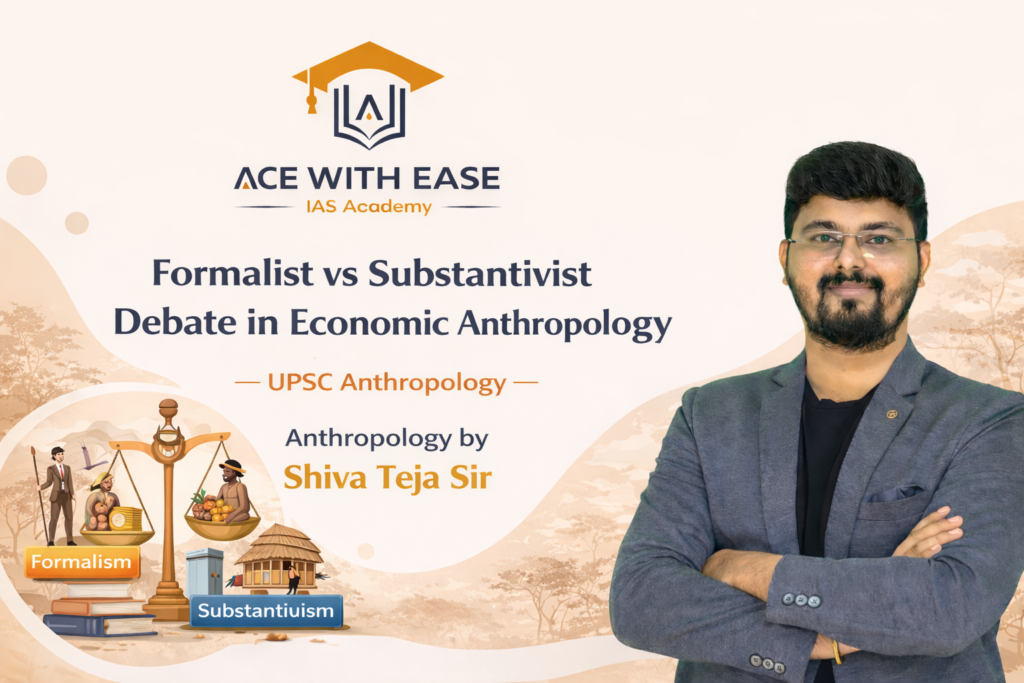
Formalist vs Substantivist Debate in Economic Anthropology — UPSC Anthropology Paper 1
⏱ 16 min read | ~3480 words
Can you apply the logic of a Wall Street trader to understand why a Trobriand Islander spends months preparing a canoe to sail hundreds of miles, only to exchange a necklace for a bracelet that he’ll give away again in a year? This is the central question that divided economic anthropologists into two camps — Formalists and Substantivists — for much of the 20th century. And understanding this debate is worth 15-20 marks in UPSC Anthropology Paper 1.
The debate isn’t about ancient history. It’s about fundamental assumptions: Can we apply the principles of Western capitalism — rational choice, utility maximization, market logic — to all human societies? Or do different economic systems operate on fundamentally different logics that require different analytical frameworks? Your answer to this question determines how you analyze tribal economies, understand development, and interpret cultural change. Let’s explore one of anthropology’s most sophisticated debates.
The Origins: How the Debate Began
The debate didn’t emerge in a vacuum. It arose from a genuine intellectual crisis in the 1950s.
This seemed reasonable. But then Karl Polanyi, a Hungarian economist and historian, and his colleagues Conrad Arensberg and Harry Pearson published Trade and Market in the Early Empires in 1957 and challenged Herskovits directly. Polanyi argued that the economy in pre-industrial societies was fundamentally embedded in social and political institutions — it was organized through reciprocity and redistribution, not markets. Market exchange is not universal; it’s specific to modern capitalism. This observation exploded into a full intellectual debate that energized anthropology for decades.
The question seemed simple but was profoundly complex: Can universal economic principles explain all economies, or must we develop different frameworks for different types of societies?
Formalism: The Case for Universal Principles
The Formalist Foundation
Formalists built their argument on Lionel Robbins’ definition of economics: economics is fundamentally about the logic of rational choice. When resources are scarce and wants are unlimited, humans must choose how to allocate those resources. This choice-making is rational — it follows a logic of comparing alternatives and selecting the option that maximizes utility. This logic, Formalists argued, applies to any society with scarce resources.
1
Individuals pursue utility maximization — Every person, everywhere, seeks to maximize their welfare or satisfaction given the constraints they face. A Trobriand Islander, a Bushman hunter, and a Wall Street banker all operate on this principle.
2
The principle of rationality — Humans are rational by nature. When we observe behavior that seems irrational (like giving away wealth in a potlatch), we’re misunderstanding the constraints or preferences of the actor.
3
Universality of scarcity — Unlimited wants meet limited resources everywhere. This is a universal condition of human life.
4
Principle of diminishing marginal value — The more of something you have, the less additional satisfaction each increment provides. A third meal satisfies less than the first.
The Formalist Argument
This was appealing because it meant economics could be genuinely scientific — applying universal laws across contexts, just like physics. It also suggested that as societies developed and markets emerged, they were simply revealing economic principles that were always operating beneath the surface.
Criticisms of Formalism
But Formalism faced serious challenges:
Substantivism: The Case for Different Logics
The Substantivist Foundation
Karl Polanyi made a crucial distinction in The Great Transformation (1944). The term “economics” has two meanings:
For Polanyi, the substantive meaning was primary. Economics is fundamentally about survival — how food, shelter, and goods flow to people. Whether this happens through markets, gifts, or redistribution is secondary. And crucially, the substantive meaning doesn’t require rationality assumptions or scarcity conditions.
The Concept of Embeddedness
Polanyi’s most important insight was embeddedness: in pre-capitalist societies, the economy is embedded in social and political institutions. It’s not a separate domain. Economic activities are simultaneously kinship activities, religious activities, and political activities.
In modern capitalism, the economy has been “disembedded” — pulled out of social life and made autonomous. Markets operate by their own logic, independent of kinship or political allegiance. A shoe merchant might sell shoes to anyone, regardless of kinship. A capitalist firm follows profit logic regardless of whether workers are kin.
But in tribal and peasant societies, you cannot separate the economic from the social. A gift exchange is simultaneously an exchange of goods and a creation of social debt, kinship obligation, and prestige. To analyze it only as an economic transaction misses the point entirely.
Polanyi’s Three Modes of Exchange
This is crucial for UPSC. Karl Polanyi identified three institutional forms through which goods circulate in societies:
Key Substantivist Arguments
Critical Case Studies: Where Theory Meets Ethnography
These cases are essential for UPSC answers. They show why the debate matters.
The Kula Ring: The Substantivist Exemplar
Bronislaw Malinowski’s study of the Kula exchange among Trobriand Islanders (Melanesia) is the classic substantivist case. Here’s why it demolishes formalist logic:
In the Kula ring, spanning 18 island communities across hundreds of kilometers, two types of shell valuables circulate in opposite directions:
- 1Mwali(red shell necklaces) circulate clockwise
- 2Soulava(white armshell bracelets) circulate counterclockwise
These items are not valuable because they’re scarce or useful. In fact, they’re valueless in any practical sense. Yet Trobrianders spend enormous time and resources preparing canoes, assembling trading parties, and participating in elaborate ceremonies to exchange them.
- 1It creates and maintains alliances between distant communities
- 2It affirms kinship bonds — the partners in Kula exchange become quasi-kin with ongoing obligations
- 3It generates prestige — the best traders become renowned, and their status rises
- 4It integrates the entire ring into a single system — each island depends on relations with others
The Kula isn’t about the shells; it’s about creating and maintaining a social system. When you understand this, Kula exchange becomes economically rational from a different perspective — one that values social integration.
Malinowski also showed that alongside the Kula ring, Trobrianders engaged in ordinary barter and trade — buying and selling in markets. But they kept this sphere separate from the Kula. This supports Polanyi’s point: societies can have multiple modes of exchange operating simultaneously, but in different spheres. Rational choice logic applies to the barter; reciprocity logic applies to the Kula.
The Potlatch: Redistribution and Prestige
The potlatch ceremony of the Kwakiutl and other Northwest Coast First Nations of North America provides another substantivist case.
A potlatch is a public feast hosted by a chief or wealthy person. The host accumulates goods — blankets, canoes, food, copper sheets. Then in a ceremonial gathering, the host distributes these goods lavishly to guests and sometimes destroys them publicly. The more you give away and destroy, the more prestige you gain. Giving away wealth is the path to power and status.
Again, from a substantivist perspective, the potlatch makes perfect sense — but only when you understand it as a redistributive institution serving multiple social functions, not as an economic exchange seeking profit.
Colonial Impact: Dalton and Bohannan on African Economies
Daryll Forde and Mary Douglas studied how African economies transformed under colonialism. The Tiv of Nigeria provide a instructive example, analyzed by Paul and Laura Bohannan.
The Tiv traditionally organized goods into multiple non-convertible spheres: subsistence goods (yams, local craft items) were exchanged in local markets; prestige goods (brass rods, slaves) were exchanged in their own sphere; marriage and kinship transactions were in a third sphere. The spheres had different values — you could exchange a certain amount of subsistence goods for prestige goods, but the rates were culturally fixed, not market-determined.
Colonialism changed this fundamentally. The British introduced cash currency and market exchange. Suddenly, all goods could be converted into money and exchanged at market prices. This “commodification” of the economy destroyed the traditional sphere system. Prestige goods lost their special status. Labor became a commodity. Most importantly, the social meanings of transactions changed — what had been about kinship obligation and prestige now became about profit.
This case is crucial for understanding development and globalization. It shows that introducing market logic isn’t neutral — it transforms the entire economic and social system. George Dalton argued that such transformations often impoverish communities, destroying the safety nets and reciprocal obligations that protected vulnerable people.
The Contemporary Synthesis: Moving Beyond the Debate
For many decades, the Formalist-Substantivist debate seemed to be an either/or proposition. But contemporary anthropology has moved toward a more nuanced synthesis.
Prattis (1982) and Plattner (1989) argued that the strict division between “primitive” and “modern” economies is problematic. In reality, most societies are mixed systems — they have market sectors alongside reciprocal exchanges. You find reciprocal gift-giving in modern capitalist societies (within families, among friends), and you find market exchanges in traditional societies (markets have existed for thousands of years). The question isn’t whether markets exist, but what role they play in the overall system.
Moreover, in the age of globalization, purely non-market societies barely exist. Even the most isolated communities now engage with commodity markets. This means formalist principles increasingly permeate all economies. Capital flows, market pricing, wage labor — these become present everywhere.
But the substantivist insight remains crucial: even in market economies, the economy is embedded in social and cultural contexts. Family firms behave differently from multinational corporations. Labor markets are shaped by kinship and ethnic networks. Consumer behavior reflects cultural values. Substantivization of formalist economics — as Plattler termed it — means we acknowledge that market logic operates within social constraints and cultural meanings.
The most sophisticated position today is that formalism and substantivism are complementary. When analyzing a purely market economy with price-making mechanisms, formalist tools are powerful. When analyzing non-market exchanges or the social meanings underlying market transactions, substantivist tools are essential.
Key Takeaway for UPSC
The formalist-substantivist debate isn’t resolved — nor should it be. Both approaches offer insights. When analyzing contemporary tribal economies in India, for instance, you might use substantivist concepts (embeddedness, multiple spheres of exchange) to understand traditional systems, and formalist tools to analyze how market penetration changes those systems. The sophisticated candidate uses both perspectives, recognizing their different applications.
For Paper 1 answers, this means: explain that formalists and substantivists disagree fundamentally about whether universal economic principles apply universally, support your position with ethnographic examples (Kula, potlatch, Tiv economy), and show how the debate illuminates real-world issues of development and cultural change.
Next Steps: Building Your Economic Anthropology Mastery
You’ve now grasped the foundational concepts of economic anthropology and its central intellectual debate. The next crucial step is understanding modes of subsistence — how different production systems (hunting-gathering, pastoralism, agriculture) shape social organization, inequality, and cultural life. This knowledge directly connects to UPSC’s interest in tribal economies, land rights, and development.
Once you master modes of subsistence, you’ll have the complete framework to tackle any UPSC Anthropology question touching on economics, tribal life, development, or modernization. You’ll be able to analyze real policy issues — forest conservation, tribal land rights, cash cropping, market integration — with theoretical depth and ethnographic precision.
Read next: Modes of Subsistence in Economic Anthropology — Hunting-Gathering, Pastoralism, and Agriculture for UPSC Paper 1 (coming soon)
📌 UPSC Previous Year Questions
- Examiners test this debate frequently because it’s so central to economic anthropology:
- Q: “Critically examine the debate between formalists and substantivists.” (2011, 2015, 2022)
- Q: “Critically examine the formalists’ and substantivists’ views on the applicability of economic laws in the study of primitive societies.” (2015)
- Q: “Debate between formalist and substantivist approaches.” (2022)
- Q: “Explain how the Kula ring supports the substantivist position.” (Implicit in several questions)
- Q: “Discuss the role of embeddedness in understanding traditional economies.” (Multiple variations)
- Strong answers to these questions require understanding not just the positions but the reasons behind them — the ethnographic evidence that supports each view.
❓ Frequently Asked Questions